How much visible light reaches this surface?
LUX measures illuminance in lumens per square meter. Use it for desks, counters, shelves, aisles and other working or viewing surfaces.
One LUX reading tells you how much visible light reaches one point. A better indoor-lighting evaluation can also consider distribution, color temperature, supported blue-light parameters and repeatable measurements across the space.
Illuminance, color temperature and blue-light parameters should not be treated as interchangeable. Each one describes a different part of the lighting environment.
LUX measures illuminance in lumens per square meter. Use it for desks, counters, shelves, aisles and other working or viewing surfaces.
Foot-candle is lumens per square foot. Use whichever unit matches your workflow, standard or customer requirement.
Correlated color temperature provides a Kelvin value for the apparent warm-to-cool character of supported white-light sources.
AH-300 can display blue-light irradiance and percentage for supported white LED sources as a technical comparison parameter.
Indoor-lighting decisions often depend on distribution, not only peak brightness. Record repeatable positions across the work surface or room to see where light falls off and where brighter or darker zones appear.
Use consistent positions across a desk, aisle, shelf, workstation or room. Keep sensor height, orientation and relevant lighting conditions consistent.
A multi-point map can show whether one fixture creates a bright center, dark edges or inconsistent working conditions across the same space.
Start with the task and the surface being evaluated. Then choose the measurement points that represent how people actually use the space.
Compare workstations, identify darker desks and document CCT or supported white-LED differences between fixtures.
Check whether merchandise receives consistent illuminance across shelves, counters and display zones.
Map multiple positions to see where illumination drops between fixtures or along storage aisles.
Compare student desks, presentation areas and other task surfaces rather than relying on one reading at the center of the room.
Use illuminance and CCT together when checking whether different work areas are being evaluated under comparable supported white-light conditions.
Compare bedside, desk, vanity and general-room lighting without assuming one fixture represents the full space.
Record multiple points across product displays to identify uneven brightness or differences between fixture zones.
Measure at the actual work surface and compare neighboring stations under repeatable conditions.
AH-300 is designed for practical indoor-lighting checks where one illuminance number is not enough and you want to record multiple positions for comparison.
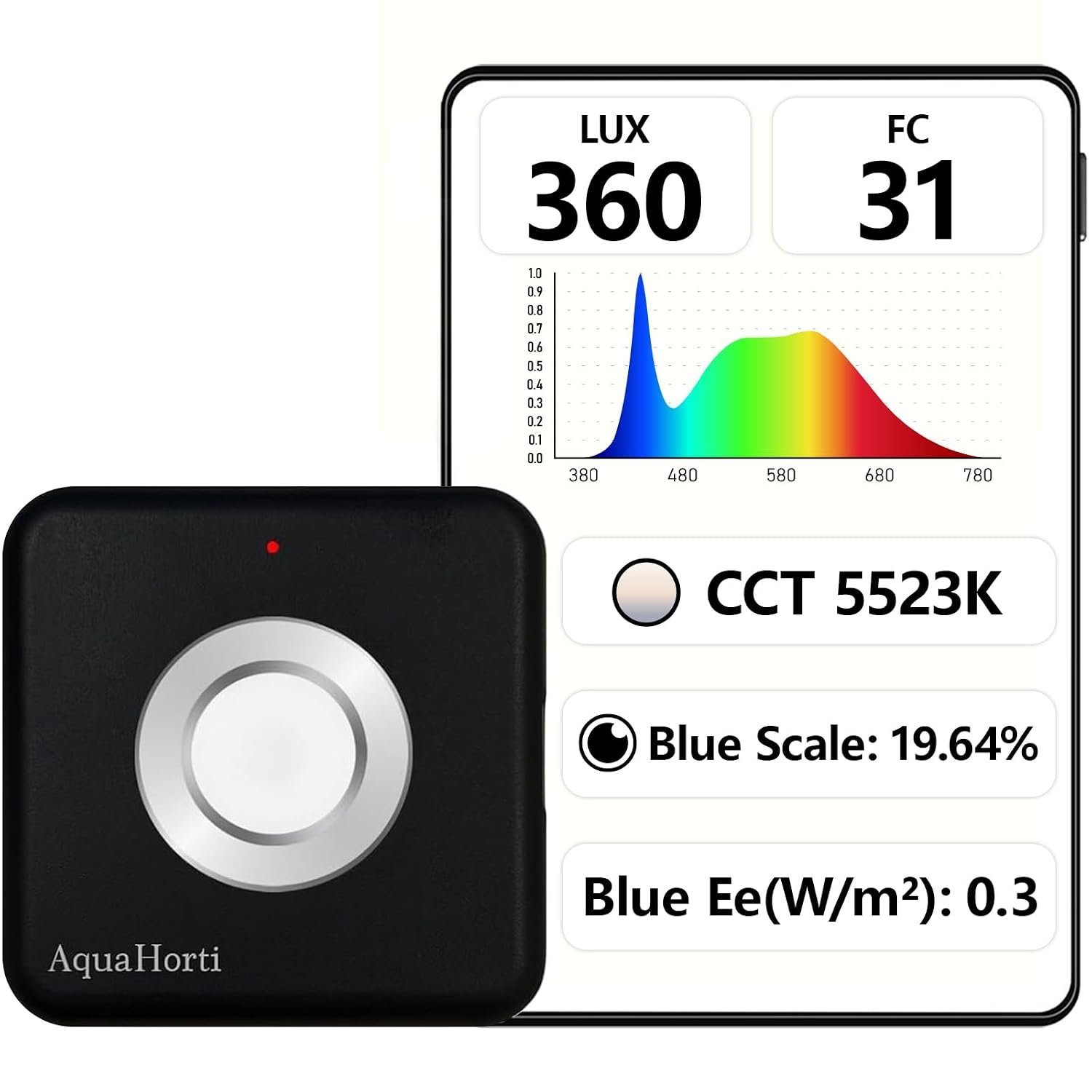
Handheld LUX / foot-candle, CCT and supported blue-light measurement with multi-point recording and spectrum preview.
A repeatable workflow makes indoor-lighting measurements more useful than isolated readings taken at random positions.
Take the reading at the surface or position that represents the real task.
Repeat at consistent points across the room, desk, shelf or aisle.
Look at distribution, CCT and supported white-LED parameters under comparable conditions.
Change fixture position, output or layout, then measure the same points again.
Both are illuminance units. LUX is lumens per square meter, while foot-candle is lumens per square foot. They describe the same type of measurement in different units.
Illuminance tells you how much visible light reaches a surface. CCT describes the apparent warm or cool character of supported white-light sources. The two measurements answer different questions.
Multiple readings reveal how light is distributed across the space. This can expose bright centers, dark edges or inconsistent work surfaces that a single reading would miss.
No. AH-300 provides a Spectrum Preview for supported white LED sources, but it is not a laboratory spectrometer and should not be treated as one.
No. Blue-light irradiance and percentage are technical lighting-comparison parameters. They are not intended for medical diagnosis, treatment decisions or health-risk assessment.
Start with the surface and decision that matter. Measure more than one point, compare like with like, and use AH-300 when the source and measurement scope match the instrument.