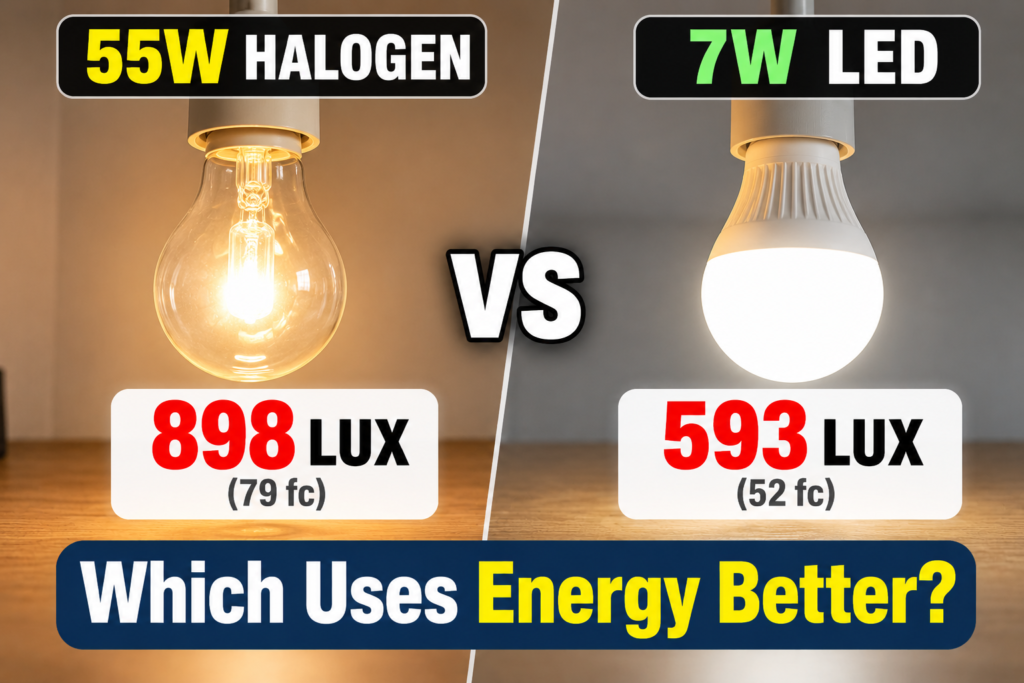
How much lighting performance can a low-wattage LED provide compared with a much higher-wattage halogen lamp?
We performed a simple side-by-side measurement using a 55W halogen lamp and a 7W LED lamp under the same tabletop test setup.
Short answer: the 55W halogen lamp measured approximately 898 lux, while the 7W LED lamp measured approximately 593 lux at the measurement point.
The LED therefore produced about 66% of the measured illuminance while using only about 12.7% of the rated power.
This was a practical lux comparison, not a laboratory luminous-efficacy test.
Watch the Original Test
The original AquaHorti test video was published on March 29, 2025.
How Was the Halogen vs LED Test Performed?
The test used the same lamp holder and a similar measurement position for both light sources.
First, a 55W halogen lamp was installed and measured.
The meter showed approximately:
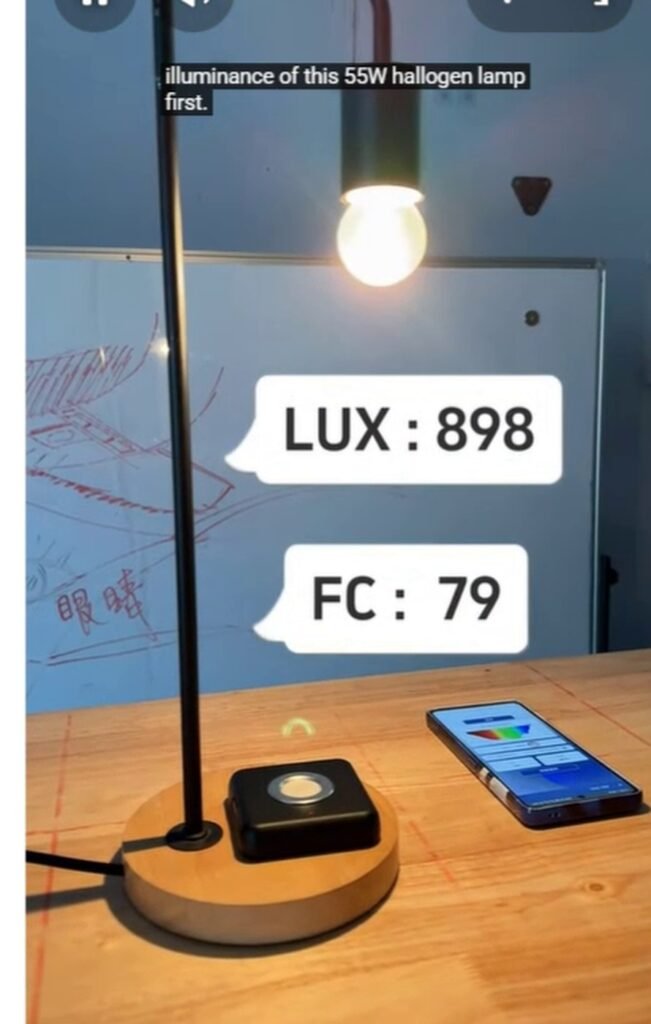
898 lux
79 fc
The halogen lamp was then replaced with a 7W LED lamp.
Under the test conditions shown in the video, the LED measurement was approximately:
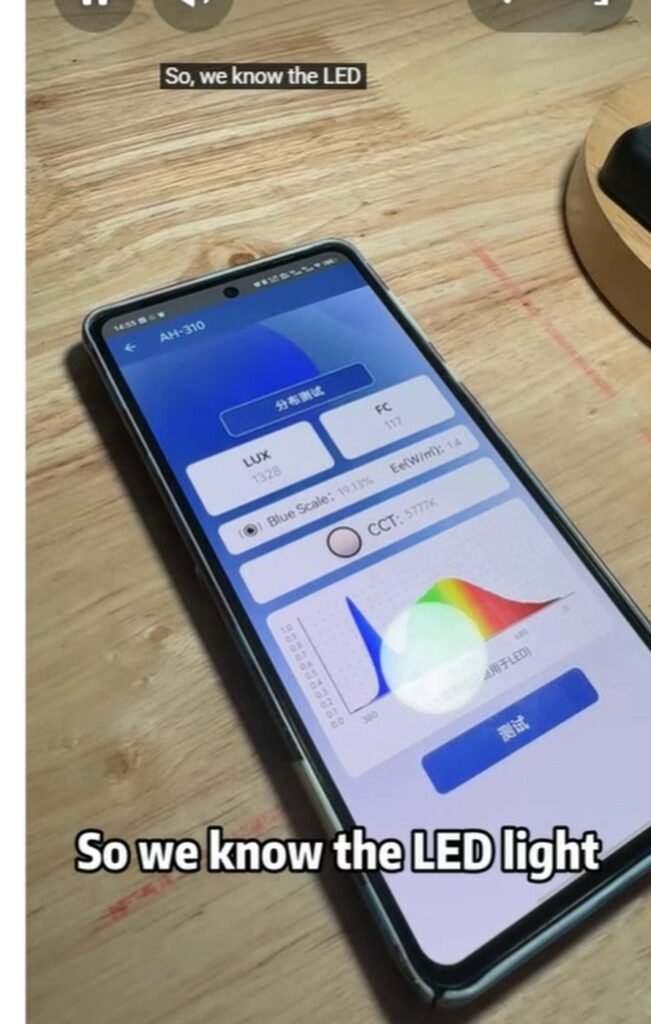
593 lux
52 fc
The comparison shows that the lower-power LED produced less illuminance at the measurement point, but required far less rated electrical power.
What Did the Lux Meter Show?
| Light source | Rated power | Illuminance | Foot-candles |
|---|---|---|---|
| Halogen lamp | 55 W | 898 lux | 79 fc |
| LED lamp | 7 W | 593 lux | 52 fc |
The 7W LED produced approximately 66.0% of the measured illuminance of the 55W halogen lamp in this setup.
At the same time, its rated power was approximately 87.3% lower.
Test result
The 7W LED produced less lux than the 55W halogen lamp, but delivered a much larger amount of measured illuminance per rated watt in this particular setup.
How Much Lower Is the Rated Power of the 7W LED?
The difference in rated power is:
55 W − 7 W = 48 W
That means the LED’s rated power is approximately 87.3% lower than the halogen lamp’s rated power.
Another way to express it is that the 55W halogen lamp has about 7.9 times the rated power of the 7W LED lamp.
However, wattage alone does not tell us how much useful light reaches a work surface.
That is why it is useful to compare both power input and measured illuminance.
Can We Calculate Efficiency From Lux and Watts?
Only as a practical comparison at the measurement point.
Using the values shown in this test:
- Halogen: 898 lux ÷ 55 W ≈ 16.3 lux per rated watt
- LED: 593 lux ÷ 7 W ≈ 84.7 lux per rated watt
In this particular setup, the LED produced roughly 5.2 times more measured illuminance per rated watt at the sensor location.
However, this is not the same as luminous efficacy in lumens per watt (lm/W).
True luminous efficacy is based on the total luminous flux emitted by the lamp divided by electrical power. Lux is illuminance measured at a specific point and is strongly affected by distance, beam angle, fixture geometry and light distribution.
Why Is Lux Different From Lumens?
Lumens describe the total visible light output of a source.
Lux describes how much visible light reaches a particular surface area.
A lamp can therefore produce fewer total lumens but still create a relatively high lux reading if its beam is more concentrated.
Conversely, a lamp with higher total light output may produce a lower reading at a particular point if the light is distributed more broadly.
For this reason, a single lux reading should not be used to claim the total lumen output of a lamp.
Why Are LEDs Usually More Energy Efficient?
LEDs convert electrical energy into visible light more efficiently than traditional incandescent-type technologies.
The U.S. Department of Energy defines lighting efficacy in terms of the amount of light produced per unit of electrical power and notes that LED technology can achieve substantially higher efficacy than traditional light sources.
This does not mean that every low-wattage LED will automatically produce more lux than every higher-wattage halogen lamp.
Actual results depend on:
- LED design,
- beam angle,
- fixture optics,
- lamp position,
- distance,
- color temperature,
- and the measurement point.
Test Limitations
This was a practical demonstration rather than a standardized laboratory efficiency test.
The video does not document calibrated electrical power consumption, total lumen output, exact beam-angle equivalence, identical spectral distribution or controlled photometric geometry.
The two lamps also use different lighting technologies and may distribute light differently.
The results should therefore be interpreted as a point illuminance comparison under the conditions shown in the video, not as a certified luminous-efficacy measurement.
What Is the Most Useful Takeaway?
The test demonstrates why wattage and brightness should not be treated as the same thing.
The 7W LED used much less rated power than the 55W halogen lamp while still producing a substantial amount of illuminance at the measurement point.
For practical lighting comparisons, measuring lux at the actual work surface can help determine whether a lower-power replacement still provides enough usable illumination.
Related LED Measurement Test
For another real-world LED measurement, see our Does LED Brightness Decrease Over Time? 2-Year vs 6-Month Lux Test.
About the Meter Shown in the Video
The original 2025 video shows AH-310 in the app interface.
AquaHorti’s current indoor-light measurement product is AH-300, which supports LUX/FC, CCT and additional lighting measurements.
Learn more: AH-300 Light Meter – LUX, CCT & Blue-Light Measurement
Frequently Asked Questions
Is a 7W LED brighter than a 55W halogen lamp?
Not in this particular test. The 55W halogen lamp measured approximately 898 lux, while the 7W LED measured approximately 593 lux at the sensor position.
How much lower was the LED’s rated power?
Based on the lamp ratings, the 7W LED has approximately 87.3% lower rated power than the 55W halogen lamp.
Did the LED produce less light?
At the specific measurement point, yes. The LED produced about 66% of the halogen lamp’s measured illuminance.
Was the LED 12 times more energy efficient?
The measurements shown in this test do not support a 12× efficiency conclusion. Using measured lux divided by rated wattage as a simple point comparison gives a ratio of approximately 5.2×, but this is not the same as standardized luminous efficacy in lumens per watt.
Can lux be used to calculate lumens?
Not directly from a single measurement. Lux depends on distance, beam angle and the area over which the light is distributed.