Does Higher Color Temperature Mean More Blue Light? A Real Measurement Test
Warm white, neutral white and cool white lamps can look very different to the eye.
One of the reasons is that their spectral composition is different.
But how does the blue portion change as the correlated color temperature increases?
In this real-world test, we measured three different white-light conditions and compared the instrument’s reported:
CCT — Correlated Color Temperature
and
Blue Scale %
The three measurements were:
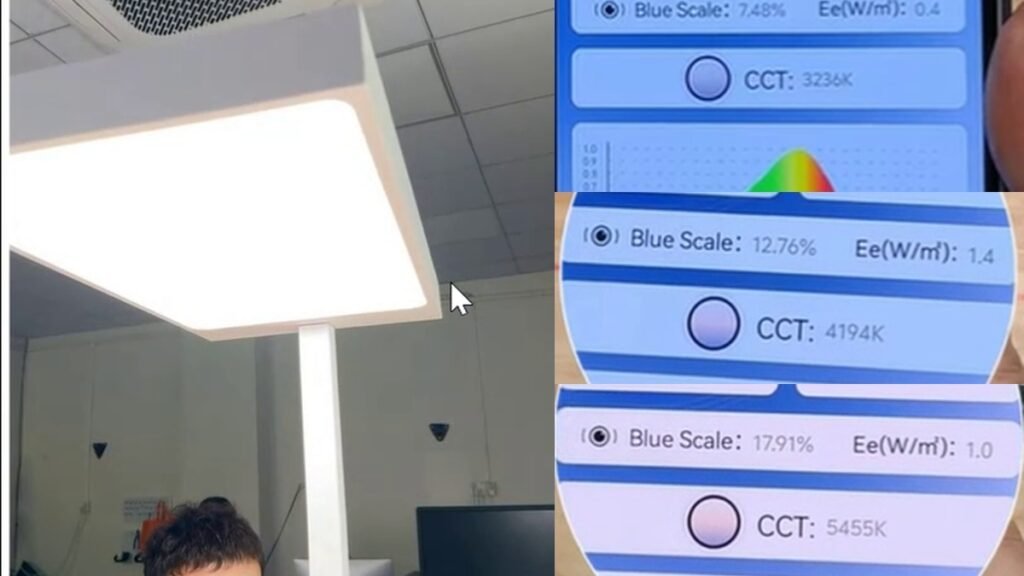
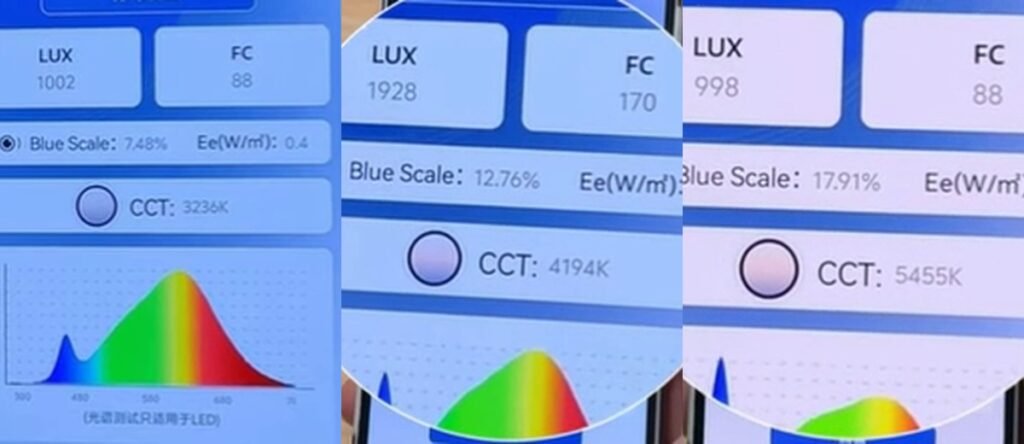
3236 K → 7.48%
4194 K → 12.76%
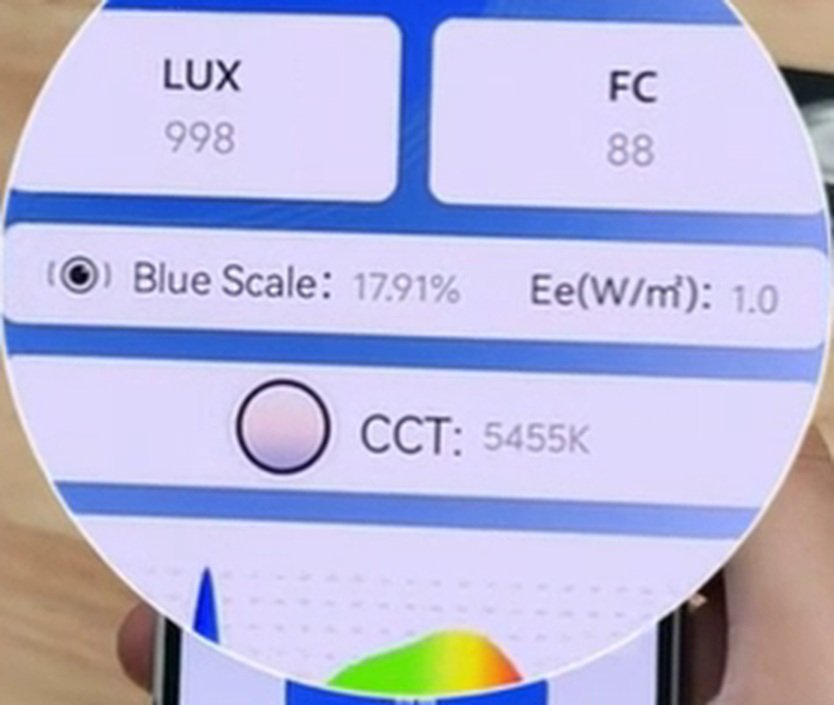
5455 K → 17.91%
Under the conditions of this test, the reported Blue Scale percentage increased as the measured color temperature increased.
Quick Answer
The results were:
Color temperature
Blue Scale
3236 K
7.48%
4194 K
12.76%
5455 K
17.91%
This follows the general tendency that cooler-looking white light with a higher color temperature often contains a greater proportion of shorter-wavelength blue light than warmer white light.
The CIE similarly notes that cooler, higher-color-temperature white lamps are generally likely to contain a higher proportion of blue light than warmer, lower-color-temperature lamps. CIE guidance on CCT and blue-light content 2.
However, CCT alone does not completely describe a lamp’s spectrum.
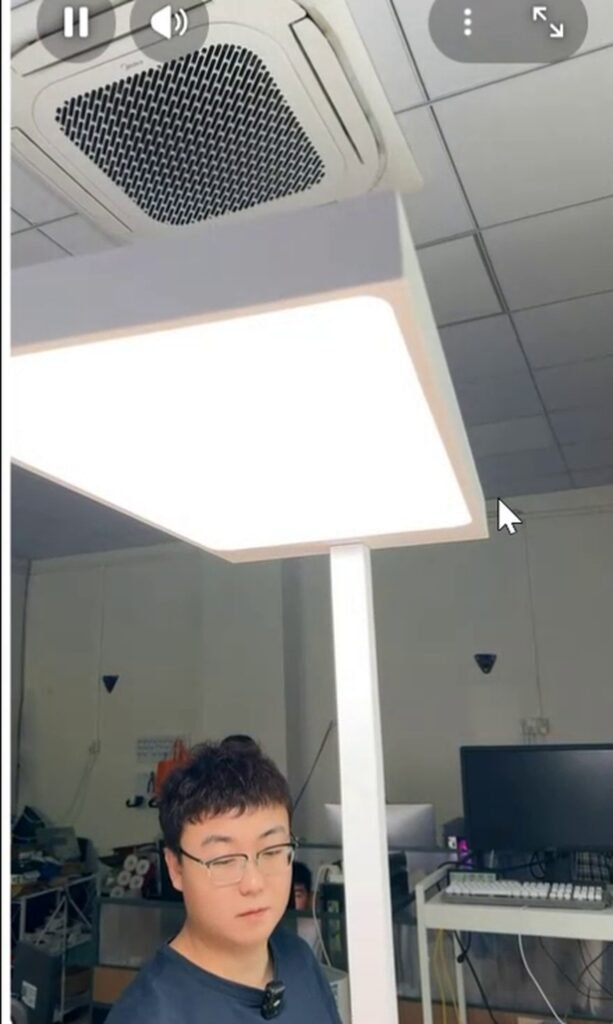
A wide-area study floor lamp used for the real-world color temperature and Blue Scale measurement test.
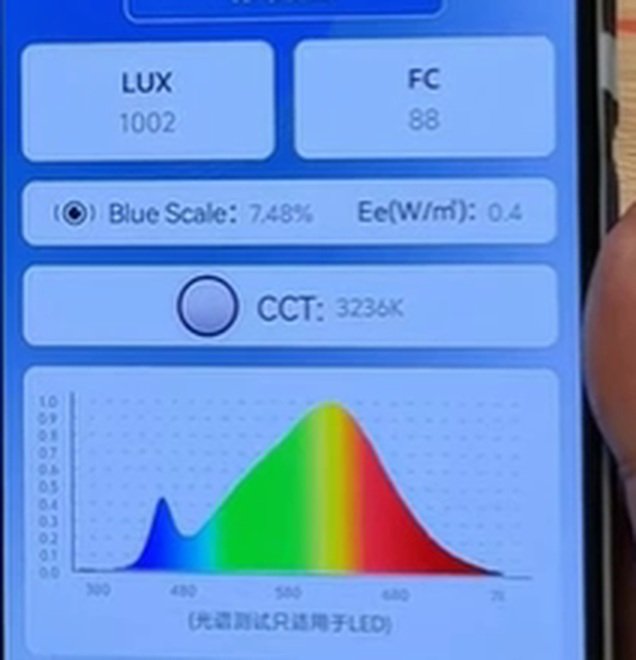
Test 1 — 3236 K Warm White Light
The first lighting condition measured approximately:
3236 K
The app reported:
Blue Scale: 7.48%
Other readings visible during the measurement were approximately:
1002 lux
and
Ee: 0.4 W/m²
This was the lowest color temperature of the three test conditions and also produced the lowest reported Blue Scale percentage.
At 3236 K, the instrument reported a Blue Scale value of 7.48%.
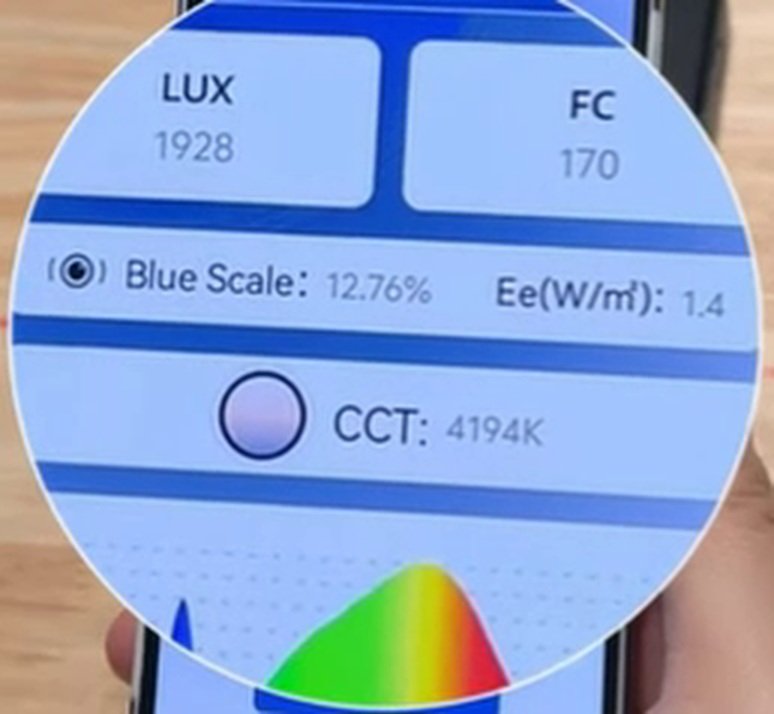
Test 2 — 4194 K Neutral White Light
The second condition measured:
4194 K
The reported Blue Scale increased to:
12.76%
The displayed illuminance was approximately:
1928 lux
and the irradiance reading shown was approximately:
1.4 W/m²
Compared with the 3236 K condition, the color appearance moved toward a cooler white and the reported Blue Scale increased.
At 4194 K, the reported Blue Scale increased to 12.76%.
Test 3 — 5455 K Cool White Light
The third measurement showed approximately:
5455 K
The reported Blue Scale increased again to:
17.91%
The instrument also displayed approximately:
998 lux
and:
1.0 W/m²
Among the three test conditions, this was both the highest measured CCT and the highest reported Blue Scale percentage.
At 5455 K, the instrument reported the highest Blue Scale value in this test: 17.91%.
Watch the full real-world CCT and Blue Scale comparison below:
What Did the Three Measurements Show?
The progression was clear:
3236 K → 7.48%
4194 K → 12.76%
5455 K → 17.91%
So for this lamp and these measured settings:
Higher CCT corresponded with a higher reported Blue Scale percentage.
This is consistent with the general relationship described by the CIE for white-light sources: higher-color-temperature light tends to contain a larger blue component. CIE guidance on CCT and blue-light content 3.
But there is an important limitation.
Does CCT Tell You the Exact Amount of Blue Light?
No.
CCT describes the color appearance of white light.
It does not uniquely define the spectral power distribution.
Two lamps could both be labeled:
4000 K
while producing different spectral distributions.
The U.S. Department of Energy demonstrates that light sources can have the same chromaticity and CCT while having different spectral power distributions. DOE color and spectrum research
That means you should not assume that every:
3000 K lamp = 7.48%
or every:
5500 K lamp = 17.91%.
Those percentages belong specifically to the light conditions measured in this test.
Why Measure the Spectrum Instead of Looking Only at CCT?
CCT is very useful.
It gives us a convenient way to describe whether white light appears:
warm;
neutral;
or cool.
But if the goal is to understand the actual composition of the light, spectral information adds another layer.
For example, two white lamps may visually look similar while distributing their radiant energy differently across the visible spectrum.
That is why lighting measurement can include both:
CCT
and
spectral information.
NIST also notes that modern solid-state lighting allows substantial flexibility in spectral design, meaning color appearance and spectral composition are related but not interchangeable concepts NIST spectral lighting research
Is the Blue Scale Percentage the Same as Blue-Light Hazard?
No.
This distinction is important.
The Blue Scale % shown in this test is a measurement metric reported by the instrument/app.
It should not automatically be interpreted as:
eye-damage risk;
a photobiological safety rating;
exposure limit;
or a medical risk percentage.
The CIE defines blue light hazard specifically as a potential photochemical retinal injury associated with a wavelength-dependent exposure assessment.
You may notice that the three measurements did not have identical illuminance:
3236 K — 1002 lux
4194 K — 1928 lux
5455 K — 998 lux
Therefore, this was not a laboratory test in which every lighting variable was held constant.
The purpose of the video was to observe the instrument-reported CCT and Blue Scale values under three real lighting conditions.
The comparison is useful as a practical demonstration, but it should not be interpreted as a controlled scientific determination of the universal relationship between CCT and blue-light percentage.
That distinction makes the test more defensible.
What Does This Test Actually Show?
This real-world measurement showed:
3236 K — 7.48% Blue Scale
4194 K — 12.76% Blue Scale
5455 K — 17.91% Blue Scale
Within these three measurements, the reported Blue Scale increased with increasing CCT.
The result is consistent with the general tendency for cooler white lamps to contain a greater blue component.
However, the precise percentage depends on the spectral characteristics of the particular light source.
What This Test Does Not Prove
This test does not prove that:
every 3236 K lamp has 7.48% blue content;
every 4194 K lamp has 12.76%;
every 5455 K lamp has 17.91%;
CCT alone determines a lamp’s exact spectrum;
Blue Scale % is the same as blue-light hazard;
a higher Blue Scale value automatically means unsafe lighting;
or these three measurements represent every LED lamp.
The values are measurements from the specific lighting conditions shown in this video.
Frequently Asked Questions
Does higher color temperature usually contain more blue light?
For many white-light sources, higher CCT generally corresponds with a greater blue component. The CIE notes this general relationship for warm and cool white lamps. CIE position statement on blue-light hazard 6.
Does 5000 K always have the same blue-light percentage?
No. Different light sources can have different spectral power distributions even when they have similar CCT values. DOE color and spectrum research
What was the Blue Scale at 3236 K?
The instrument reported approximately 7.48%.
What was the Blue Scale at 4194 K?
The instrument reported approximately 12.76%.
What was the Blue Scale at 5455 K?
The instrument reported approximately 17.91%.
Is Blue Scale % the same as blue-light hazard?
No. A spectral blue proportion and a formal blue-light-hazard assessment are different measurements. Blue-light hazard requires a wavelength-weighted photobiological exposure assessment. CIE position statement on blue-light hazard
Can CCT fully describe a lamp’s spectrum?
No. CCT describes the color appearance of white light, but different spectral power distributions can produce similar CCT values. DOE color and spectrum research
Test Conclusion
This test compared three white-light conditions:
3236 K → 7.48%
4194 K → 12.76%
5455 K → 17.91%
In this test, the reported Blue Scale increased from 7.48% at 3236 K to 12.76% at 4194 K and 17.91% at 5455 K.
For these measurements, increasing color temperature corresponded with an increasing reported Blue Scale percentage.
The main lesson is therefore not:
“Every high-CCT lamp contains exactly this much blue light.”
It is:
CCT and spectral composition are related, but CCT alone does not fully describe the spectrum of a light source.
Measuring both provides more information than relying on color temperature alone.
Test Information
Meter: AquaHorti AH-300 Test type: CCT and Blue Scale comparison Measurement 1: 3236 K / 7.48% Blue Scale / 1002 lux Measurement 2: 4194 K / 12.76% Blue Scale / 1928 lux Measurement 3: 5455 K / 17.91% Blue Scale / 998 lux Original video date: March 17, 2025 Original video duration: approximately 39 seconds