How Much Does LED Brightness Drop After Warm-Up? A Real 15-Minute Illuminance Test
LED lamps do not necessarily produce exactly the same light output from the moment they are switched on until they reach their normal operating temperature.
As the LED package, driver and luminaire warm up, temperature can affect LED efficiency and therefore light output.
So we performed a simple real-world test:
Measure the illuminance immediately after switching the lamp on, then measure the same position again after approximately 15 minutes.
The result was:
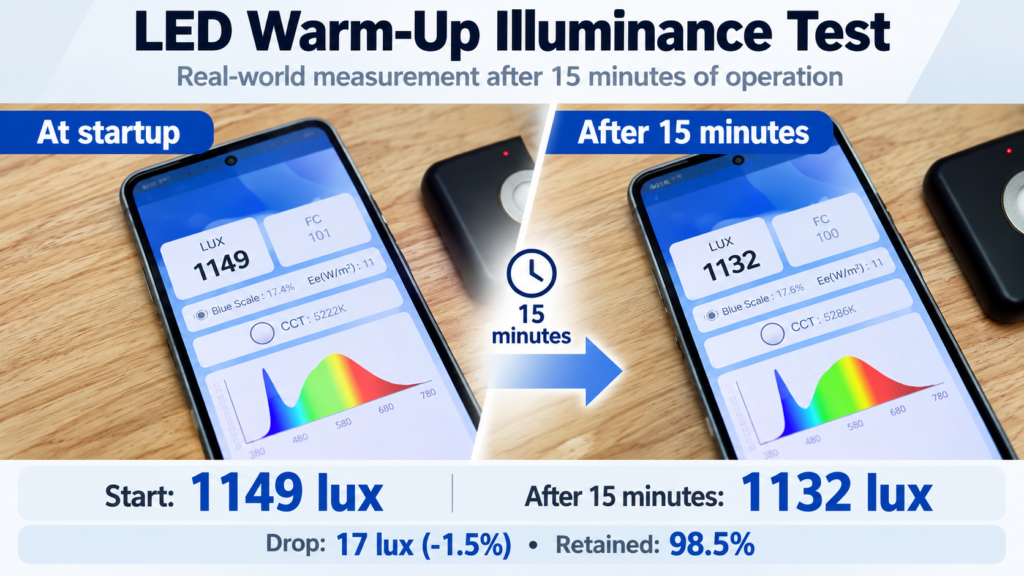
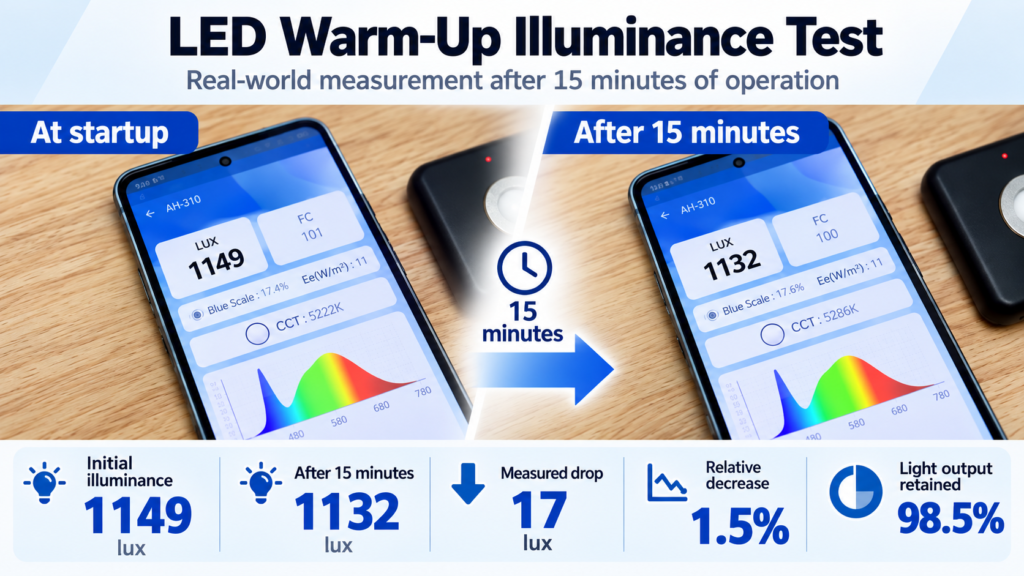
Initial illuminance: 1149 lux
After 15 minutes: 1132 lux
That is a decrease of:
17 lux
or approximately:
1.5%
Quick Answer
In this test, the lamp retained approximately:
98.5% of its initial illuminance after 15 minutes.
The measured change was:
1149 lux → 1132 lux
This is a relatively small short-term decrease under the conditions of this test.
However, this does not by itself prove:
long-term LED lifetime;
overall luminaire quality;
heat-sink temperature;
LED junction temperature;
or long-term lumen maintenance.
It is best described as a:
short-term light-output stability test during warm-up.
Why Can LED Light Output Change as the Lamp Warms Up?
LED performance is temperature-dependent.
The U.S. Department of Energy notes that LED junction temperature affects efficiency and that relative lumen output generally decreases as junction temperature increases. This temperature-related reduction is commonly referred to as thermal droop. DOE LED thermal droop research
That means measuring a lamp only during the first few seconds after switch-on may not always represent its light output after it has warmed up.
Test Setup
For this real-world test, we kept the light meter in the same measurement position.
The lamp was switched on and the initial illuminance was recorded.
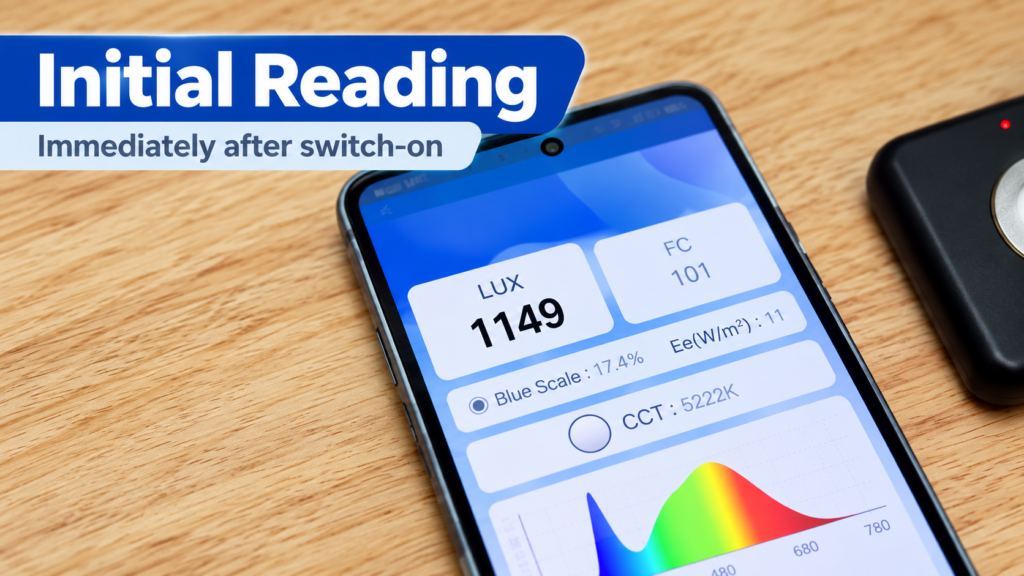
The first reading was approximately:
1149 lux
The initial illuminance measured approximately 1149 lux shortly after the LED lamp was switched on.
We then left the lamp operating.
No attempt was made to measure LED junction temperature or heat-sink temperature.
The goal was simply to observe whether the measured illuminance changed after the lamp had been operating for a period of time.
Initial Illuminance: 1149 Lux
Shortly after the lamp was switched on, the light meter displayed approximately:
1149 lux
This value serves as the baseline for the test.
We then allowed the lamp to continue operating for approximately:
15 minutes
without intentionally changing the measurement position.
After 15 Minutes: 1132 Lux
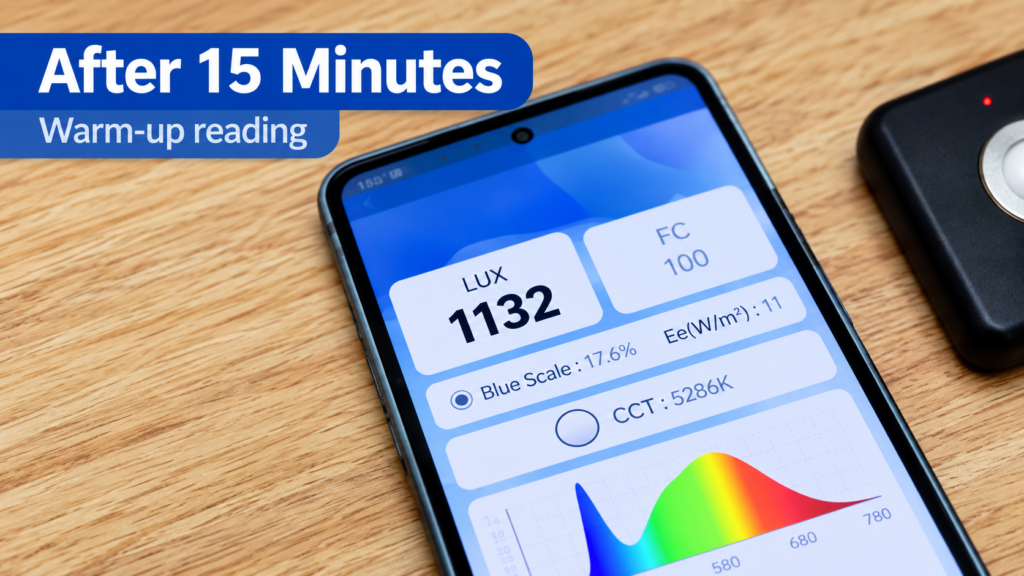
After approximately 15 minutes of operation, the measured illuminance was:
1132 lux
After approximately 15 minutes of operation, the measured illuminance was 1132 lux.
Compared with the initial reading:
1149 − 1132 = 17 lux
The relative light-output retention was approximately:
98.5%
The lamp retained approximately 98.5% of its initial measured illuminance, corresponding to a decrease of about 1.5%.
while the measured decrease was approximately:
1.5%
This indicates that the illuminance at the measurement point changed only modestly during this 15-minute warm-up period.
Watch the Real Test
Watch the full real-world LED warm-up illuminance test below:
Is a 1.5% Drop Good?
It shows that the lamp’s measured illuminance was relatively stable during this particular 15-minute test.
But we should be careful with the interpretation.
From these two measurements alone, we cannot determine:
the actual LED junction temperature;
the heat-sink temperature;
whether the lamp had reached full thermal equilibrium;
how another sample of the same lamp would behave;
or how the lamp will perform after thousands of operating hours.
So the most defensible conclusion is:
The tested lamp showed only a small short-term illuminance decrease during the first 15 minutes of operation.
It is better not to turn that into a universal claim such as:
“This proves the lamp has excellent heat dissipation.”
Why Not Just Touch the Heat Sink?
Feeling a lamp or heat sink by hand does not provide a reliable measurement of LED junction temperature.
A surface that feels warm does not automatically mean the LED junction is operating too hot, and a cooler-feeling housing does not automatically prove optimal internal thermal management.
For a simple practical comparison, measuring light output before and after warm-up can show whether the delivered illuminance changes.
But thermal engineering evaluation requires appropriate temperature measurement and manufacturer data.
DOE notes that LED thermal management depends on junction temperature, package design, drive current, heat sinking and airflow. DOE LED thermal-management guidance
Is This the Same as Long-Term Lumen Depreciation?
No.
This distinction is very important.
A 15-minute warm-up test looks at short-term changes as the lamp reaches its normal operating condition.
Lumen depreciation, on the other hand, describes gradual loss of light output over long operating periods.
DOE explains that standardized LED lumen-maintenance testing such as IES LM-80 uses thousands of hours of data; historical LM-80 procedures required at least 6,000 hours for lumen-maintenance measurements and projections. DOE LED lumen-maintenance guidance
Therefore:
15 minutes ≠ LED lifetime test
and:
1.5% warm-up drop ≠ long-term lumen depreciation rate
What Does Thermal Equilibrium Mean?
As an LED luminaire operates, temperatures within the LED package, heat sink, housing and surrounding air change.
Eventually, the system may approach a relatively stable operating-temperature condition.
This is often referred to as reaching or approaching thermal equilibrium.
However, our video did not directly measure temperature over time.
Therefore, it would be too strong to claim that the lamp had definitely reached complete thermal equilibrium after exactly 15 minutes.
A more accurate description is:
the lamp had been operating continuously for approximately 15 minutes.
Why Keep the Sensor Position the Same?
Illuminance depends strongly on geometry.
Moving the sensor, lamp, table or measurement angle can change the lux reading even if the lamp itself has not changed.
For a meaningful before-and-after comparison, the measurement conditions should remain as consistent as possible:
same lamp position;
same sensor position;
same distance;
same sensor orientation;
same brightness setting;
same surrounding lighting.
Otherwise, position changes could be mistaken for thermal light-output changes.
Can Lux Be Used to Compare Warm-Up Stability?
Yes, with limitations.
Lux measures illuminance at a specific surface position.
If the geometry remains unchanged, comparing lux at the same point before and after warm-up provides a practical way to observe changes in delivered light output.
But lux is not a direct measurement of:
junction temperature;
electrical power;
total luminaire lumens;
or long-term lifetime.
This test therefore evaluates:
desk-level illuminance stability
rather than the complete thermal performance of the LED system.
What Does This Test Actually Show?
This real-world test recorded:
1149 lux at the beginning
and:
1132 lux after approximately 15 minutes
The absolute difference was:
17 lux
The measured illuminance retention was approximately:
98.5%
and the decrease was approximately:
1.5%
Under these test conditions, the lamp therefore showed a relatively small change in delivered illuminance during the first 15 minutes of operation.
What This Test Does Not Prove
This test does not prove that:
the lamp will lose only 1.5% over its lifetime;
the LED junction temperature is low;
the heat sink is optimally designed;
every sample of the lamp will behave identically;
the lamp has reached exact thermal equilibrium after 15 minutes;
the lamp meets a particular lifetime standard;
or a larger short-term drop automatically means a lamp is poor quality.
Those conclusions would require additional measurements and longer-duration testing.
Frequently Asked Questions
Do LEDs become slightly dimmer as they warm up?
They can. LED light output is temperature-dependent, and higher junction temperature can reduce light output. DOE describes this temperature-related effect as thermal droop. DOE LED thermal droop research 6.
What was the initial illuminance in this test?
Approximately 1149 lux.
What was the illuminance after 15 minutes?
Approximately 1132 lux.
How much did the illuminance decrease?
The measured decrease was 17 lux, or approximately 1.5% of the initial reading.
How much light output remained after 15 minutes?
Approximately 98.5% of the initial illuminance remained at the measurement point.
Does this prove the lamp has good heat dissipation?
Not by itself. The small change shows good short-term illuminance stability in this test, but thermal-system performance requires additional temperature and engineering measurements.
Is this a lumen-maintenance or lifetime test?
No. A 15-minute warm-up comparison is very different from standardized long-term LED lumen-maintenance testing, which uses thousands of operating hours. DOE LED lumen-maintenance guidance
Should I judge LED temperature by touching the lamp?
Touch can tell you whether a surface feels warm, but it does not measure LED junction temperature or provide a complete assessment of thermal management.
Test Conclusion
In this real-world warm-up test, illuminance changed from:
1149 lux
to:
1132 lux
after approximately:
15 minutes
The measured difference was:
17 lux
or approximately:
1.5%
This means the lamp retained approximately:
98.5% of the initial measured illuminance.
The most appropriate conclusion is:
The tested lamp showed a small short-term decrease in illuminance during its first 15 minutes of operation.
This type of before-and-after lux measurement can be useful for comparing short-term light-output stability.
But it should not be confused with a complete thermal evaluation or a long-term LED lifetime test.
Test Information
Meter: AquaHorti AH-300 Test type: LED warm-up illuminance stability test Initial illuminance: approximately 1149 lux Illuminance after 15 minutes: approximately 1132 lux Absolute decrease: 17 lux Measured decrease: approximately 1.5% Illuminance retained: approximately 98.5% Observation period: approximately 15 minutes Original video date: April 1, 2025 Original video duration: approximately 36 seconds