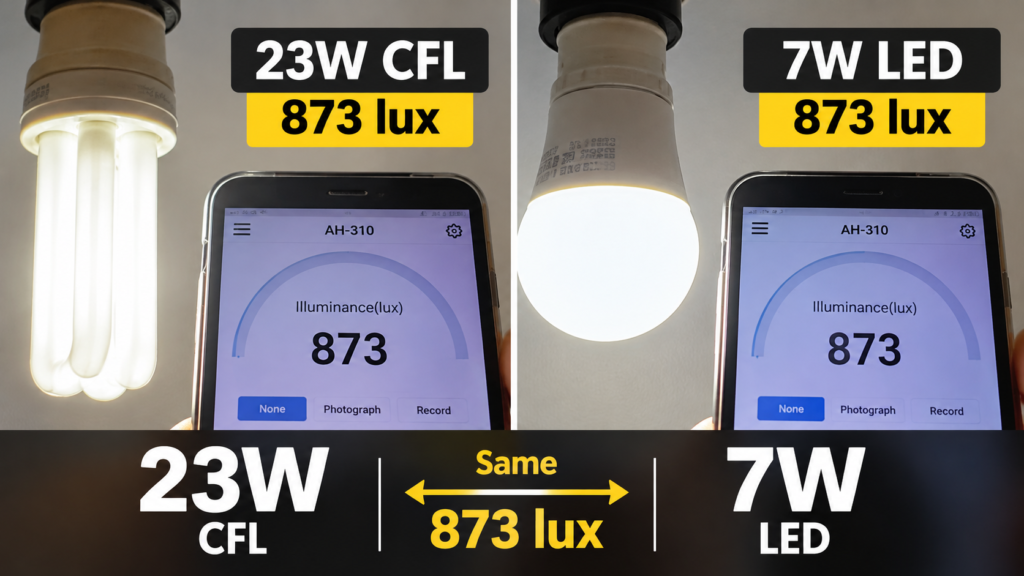
A lower wattage does not always mean less light at a specific measurement point.
In this practical comparison, we tested a 23W compact fluorescent lamp (CFL) and a 7W LED bulb using the same lamp position and light-meter setup.
Short answer: both lamps measured approximately 873 lux at the sensor position, while the LED’s rated power was only 7W compared with 23W for the CFL.
That means the LED had approximately 69.6% lower rated wattage while producing the same measured point illuminance in this test.
Watch the Original CFL vs LED Test
The original AquaHorti test video was published on April 15, 2025.
How Was the CFL vs LED Test Performed?
The test used the same lamp holder and approximately the same measurement position.
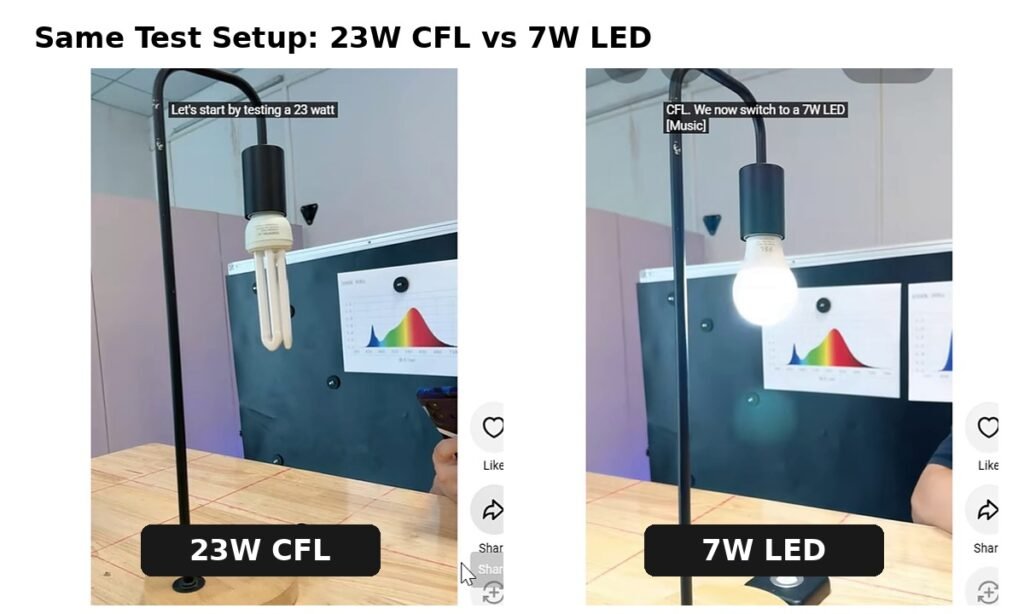
First, a 23W CFL was installed and measured.
The CFL produced approximately:
873 lux
The CFL was then replaced with a 7W LED bulb, while the general test setup remained similar.
The LED also produced approximately:
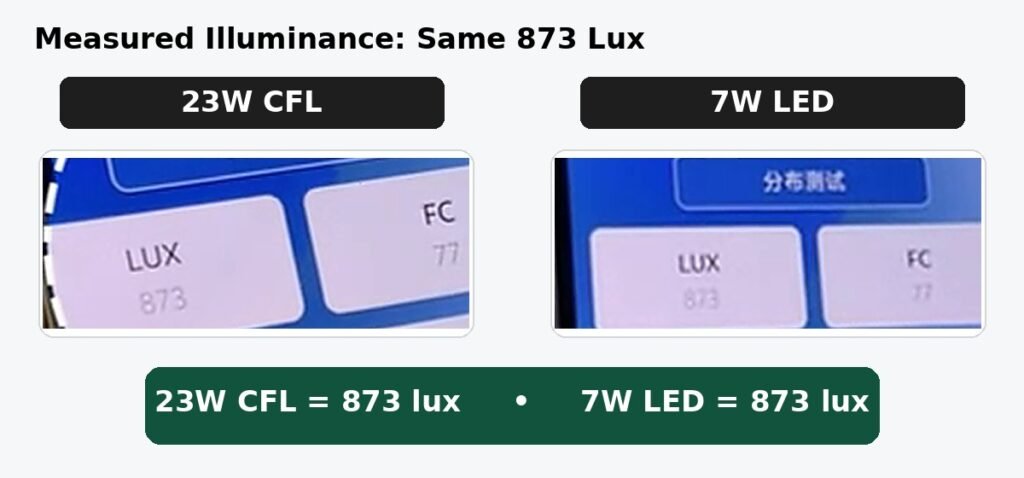
873 lux
This makes the comparison useful as a practical example of how two lamps with very different rated wattages can produce similar illuminance at one measurement point.
What Did the Meter Show?
| Lamp | Rated power | Measured illuminance |
|---|---|---|
| 23W CFL | 23 W | 873 lux |
| 7W LED | 7 W | 873 lux |
Test result
Both lamps produced the same measured point illuminance of approximately 873 lux in this setup.
The difference was in their rated power:
23W → 7W
That is a reduction of:
16 W
or approximately:
69.6% lower rated wattage
for the LED.
Does This Mean the 7W LED Is More Efficient?
The result strongly suggests that the LED delivered the same point illuminance with a much lower rated wattage in this setup.
However, this test does not measure standardized luminous efficacy.
The U.S. Department of Energy defines lighting efficacy in lumens per watt (lm/W) — total light output divided by electrical power input.
This video measures:
lux at one point
rather than:
total lumens
and it uses the lamps’ rated wattages rather than a separate electrical power measurement.
Therefore, the test should be interpreted as a practical point-illuminance comparison, not a laboratory lm/W efficiency measurement.
What Is the Simple Lux-per-Rated-Watt Comparison?
If we divide the measured point illuminance by the lamps’ rated wattages:
For the 23W CFL:
873 lux ÷ 23 W ≈ 38.0 lux per rated watt
For the 7W LED:
873 lux ÷ 7 W ≈ 124.7 lux per rated watt
The LED’s simple point-illuminance-per-rated-watt figure is therefore about:
3.29× higher
in this particular setup.
But this number should not be called standard luminous efficacy.
It is only a comparison based on one sensor position and the lamps’ rated wattages.
Can We Say the LED Was Five Times More Efficient?
Not from the measurements shown in this video alone.
The visible data support a clear conclusion:
same 873 lux at the test point, with 7W rated power instead of 23W.
The simple lux-per-rated-watt ratio is approximately 3.29×, not 5×.
And even that 3.29× figure is not equivalent to standard lm/W efficacy because total lumen output and actual electrical input power were not measured.
For this article, the most defensible conclusion is therefore:
The 7W LED matched the 23W CFL’s 873-lux point reading while using 69.6% lower rated wattage.
What Does 873 Lux Mean?
Lux measures illuminance — how much visible light reaches a surface or sensor.
The 873-lux reading tells us how much light reached the meter at that particular position.
It does not tell us the total amount of light produced by the lamp.
Two lamps can produce the same lux reading at one point while distributing their light differently across the room.
Does the Same Lux Mean the Two Lamps Are Equally Bright Everywhere?
No.
The same point reading does not guarantee the same illumination pattern.
Differences in bulb design, diffuser shape and light distribution can affect:
- center illuminance,
- side illumination,
- beam spread,
- shadows,
- and overall room uniformity.
A more complete comparison would measure multiple positions around the lamp rather than only one point.
Why Can an LED Produce Similar Lux With Less Rated Power?
LED lighting technology can convert electrical energy into visible light more effectively than older lighting technologies.
The U.S. Department of Energy notes that luminous efficacy is measured in lumens per watt and that modern LED lighting can achieve substantially higher efficacy than many older lamp technologies.
But the exact performance depends on the specific products being compared.
This video demonstrates the performance of these two individual lamps, not every CFL and every LED.
Rated Wattage vs Actual Power
Another important limitation is that the video compares the lamps using their rated wattages:
23W CFL
and
7W LED
The test did not show a separate electrical power meter measuring the actual real-time input power of each lamp.
Rated wattage is useful for a practical comparison, but actual electrical input can differ somewhat from the nominal label.
A more rigorous test would measure both lamps with a power meter.
Test Limitations
This was a practical demonstration rather than a standardized laboratory lighting-efficiency test.
The test did not document:
- actual electrical input power,
- total lumen output,
- integrating-sphere measurements,
- multiple illuminance positions,
- lamp warm-up stabilization,
- repeated trials,
- or standardized photometric testing.
CFL output can also change as the lamp warms up, so stabilization time can matter when comparing CFL and LED lighting.
The result should therefore be interpreted as:
a 23W-rated CFL and a 7W-rated LED both measured approximately 873 lux at this particular sensor position under the conditions shown.
How Could This Test Be Improved?
A stronger comparison would measure:
1. Actual electrical power
Use a plug-in power meter for both lamps.
2. Stabilized output
Allow each lamp to reach a stable operating condition before recording the final reading.
3. Multiple lux positions
Measure the center and several surrounding points.
4. Total lumen output
For standardized luminous efficacy, measure total luminous flux and divide it by actual input power.
That would allow a proper comparison in:
lumens per watt (lm/W)
rather than relying on one lux reading.
What Is the Main Takeaway?
This simple test demonstrates an important practical point:
Wattage alone does not tell you how much illuminance will reach a specific working surface.
In this setup:
23W CFL → 873 lux
7W LED → 873 lux
The LED achieved the same measured point illuminance with 69.6% lower rated wattage.
That is the strongest conclusion supported directly by the video.
Related Lighting Measurement Tests
For another lamp comparison, see our 55W Halogen vs 7W LED: Lux and Power Comparison Test.
You can also see our 500W LED Actual Power vs Lux Test, where actual electrical input power was measured separately from illuminance.
About the Meter Shown in the Video
The original 2025 video shows AH-310 in the app interface.
AquaHorti’s current indoor-light measurement product is AH-300, which supports illuminance and correlated color-temperature measurements.
Learn more: AH-300 Light Meter – LUX & CCT Measurement
Frequently Asked Questions
What did the 23W CFL measure?
The 23W CFL measured approximately 873 lux at the test position.
What did the 7W LED measure?
The 7W LED also measured approximately 873 lux at the same general measurement position.
How much lower was the LED’s rated wattage?
The 7W LED had approximately 69.6% lower rated wattage than the 23W CFL.
Does the test prove the LED is 3.29 times more efficient?
No. The 3.29× figure comes from dividing one lux reading by rated wattage. Standard luminous efficacy requires total lumens and actual electrical input power.
Does the test prove the LED is five times more efficient?
No. The measurements shown in the video do not establish a five-times standardized efficiency difference.
Does the same lux mean both lamps produce the same total light?
No. Lux is measured at a specific position. Total lumen output and light distribution can still differ.