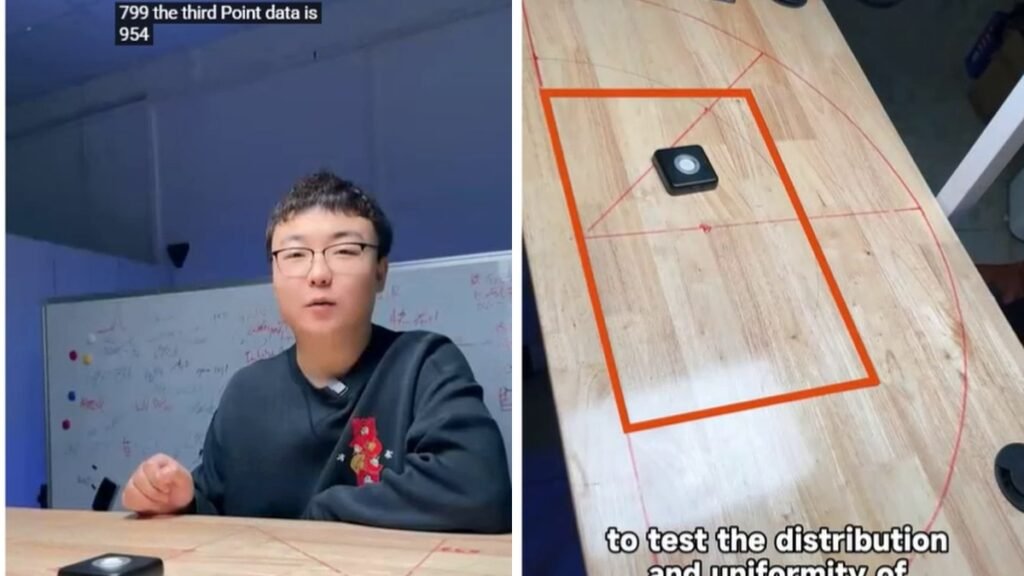
A study lamp can look extremely bright from the center of a desk while still leaving noticeably darker areas around books, notebooks and writing materials.
That is why evaluating a lamp only at one point can be misleading.
For this real-world test, we used the AH-300 light meter to measure a wide-area study floor lamp designed to illuminate a large reading and writing surface.
Instead of checking only the brightest point, we measured illumination at multiple positions across the desk and then performed a 15-point distribution test over a defined rectangular work area.
The result gives us a much clearer picture of both:
illuminance — how much light reaches the desk,
and
uniformity — how evenly that light is distributed.
Quick Answer
In this test, the wide-area study floor lamp produced strong illuminance across the main writing area.
Individual measurements shown in the video included:
558, 799, 954, 910, 314, 621 and 879 lux.
We then measured a 50 × 30 cm rectangular desk area using 15 measurement positions.
The measurement app calculated:
Average illuminance: 758.333 lux
Illuminance uniformity: 0.79
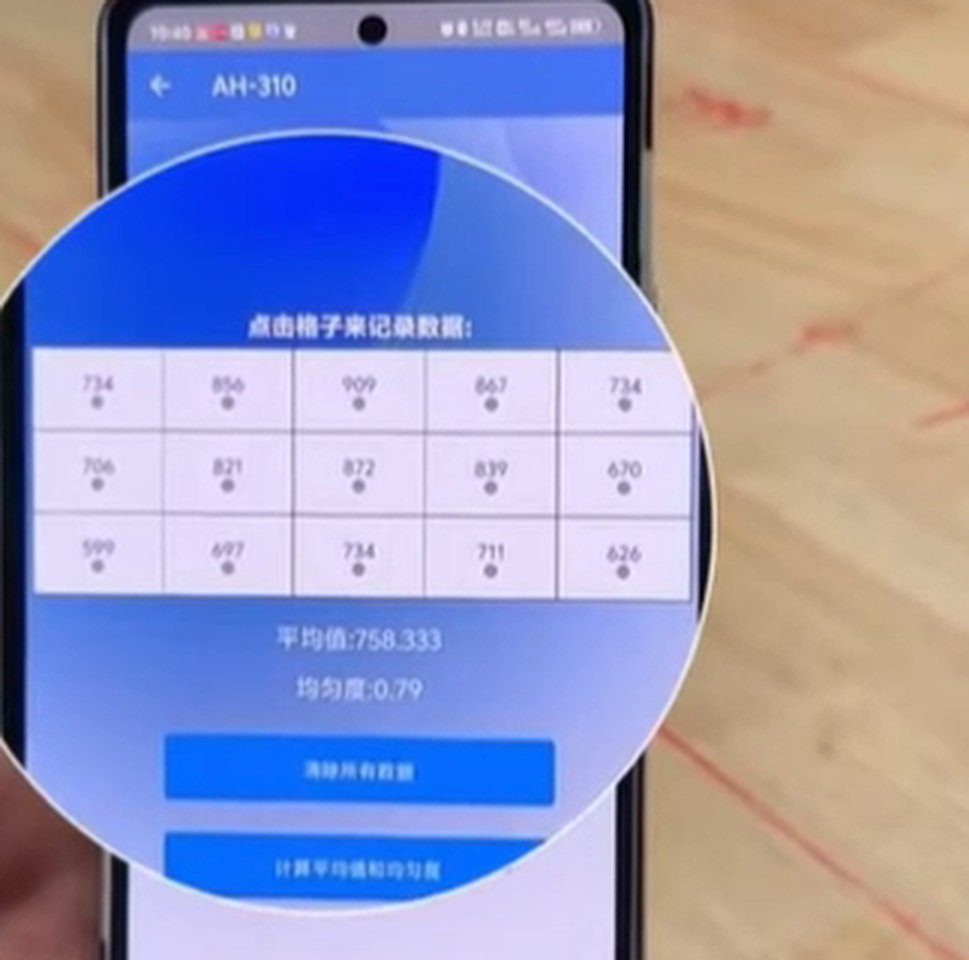
The 15-point test produced an average illuminance of 758.333 lux and an illuminance uniformity of 0.79.The key takeaway is not simply that the lamp was bright.
The more useful finding is that we could quantify how the light was distributed across the actual working surface.
What Type of Lamp Did We Test?

A wide-area study floor lamp illuminating a large reading and writing surface during the AH-300 test.The lamp in this test is best described as a:
wide-area study floor lamp
It is a standing task light designed to illuminate a large desk surface used for activities such as:
- reading;
- handwriting;
- homework;
- drawing;
- worksheets;
- books and textbooks.
Unlike a small desk lamp that concentrates most of its light in one localized area, this style of floor-standing study lamp uses a much larger light-emitting panel to illuminate a broader portion of the desk.
For this reason, measuring only the center point does not tell the whole story.
Why Measure Lux Across the Desk?
Lux describes the illuminance reaching a surface.
For reading and writing, the important question is therefore not simply:
How many lumens does the lamp produce?
but:
How much light actually reaches the pages and writing surface?
And there is another question that matters just as much:
Does the entire working area receive reasonably consistent illumination?
International lighting guidance commonly evaluates illuminance at the actual task plane. An IEA lighting guide discussing EN 12464-1 identifies approximately 500 lux as a reference level for reading and writing task areas, although the appropriate requirement depends on the application and jurisdiction. IEA reading and writing illuminance guidance
OSHA guidance similarly emphasizes providing appropriate task lighting for reading and writing rather than simply increasing the general brightness of the entire room. OSHA task lighting guidance
For a home study desk, that makes point-by-point measurement particularly useful.
Test 1 — Multiple Illuminance Points
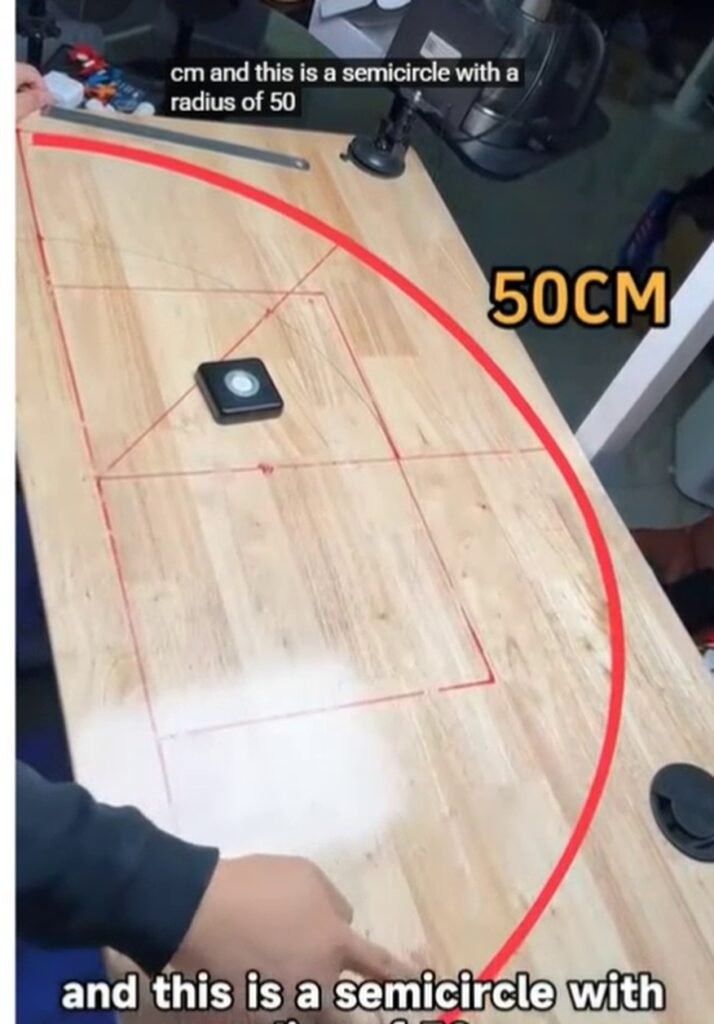
Semicircular 30 cm and 50 cm reference areas were marked on the desk for multi-point illuminance measurements.We first marked the desk using two semicircular reference lines with radii of approximately:
30 cm
and:
50 cm
We then placed the AH-300 sensor at multiple marked positions to see how the illuminance changed as the measurement location moved across the desk.
The readings clearly shown during this part of the video were:
| Measurement | Illuminance |
|---|---|
| Point 1 | 558 lux |
| Point 2 | 799 lux |
| Point 3 | 954 lux |
| Center point | 910 lux |
| Point 4 | 314 lux |
| Point 5 | 621 lux |
| Point 6 | 879 lux |
The readings demonstrate why a single center measurement is not enough.
For example, the center was approximately:
910 lux
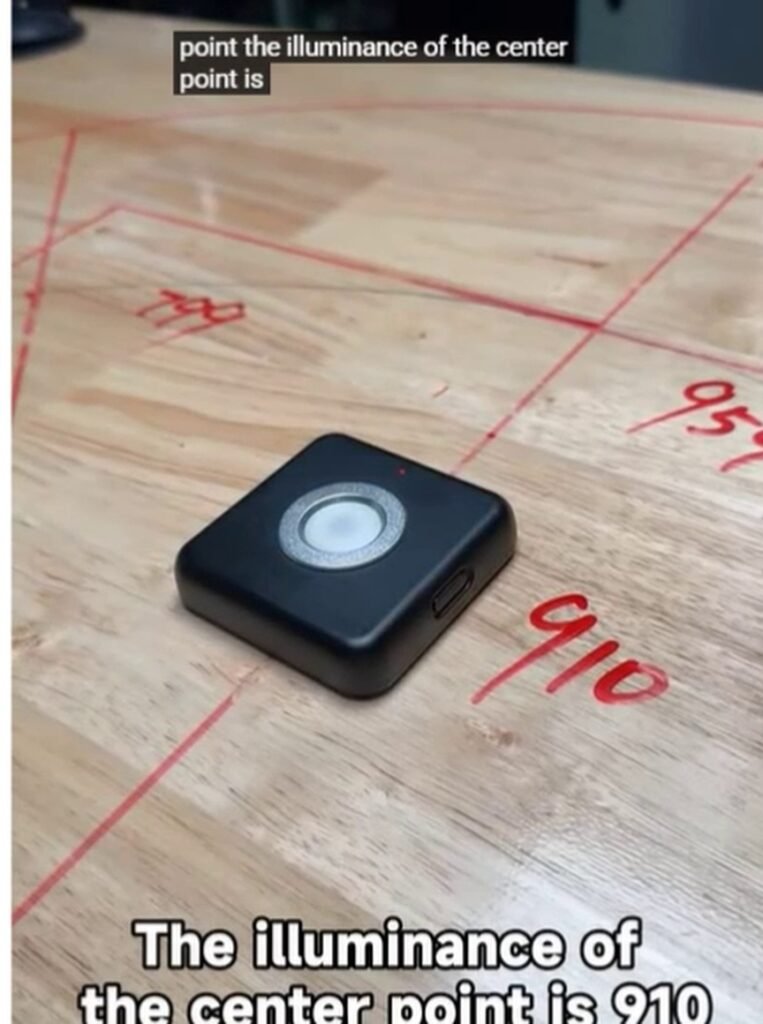
The center measurement under the study floor lamp was approximately 910 lux.while another measured position farther across the illuminated area was:
314 lux.
That difference tells us something important about the lamp’s spatial light distribution.
Is 910 Lux at the Center Enough Information?
No.
A high center reading can tell us that the lamp is capable of delivering substantial illuminance at that location.
But it cannot tell us whether a notebook placed 20 or 30 cm away receives the same amount of light.
A lamp could theoretically produce:
1,000 lux at the center
while producing much lower illuminance around the rest of the desk.
For activities involving several books, worksheets or a larger writing area, this matters.
That is why the next part of the test focuses on distribution and uniformity.
Test 2 — A 50 × 30 cm Writing Area
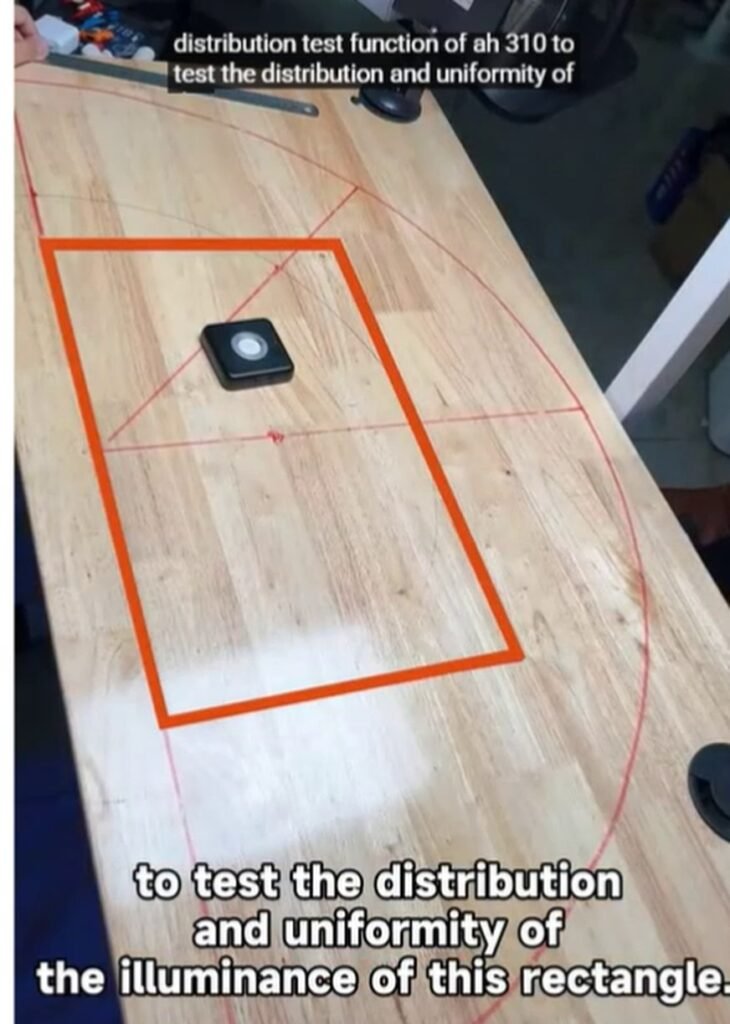
A 50 × 30 cm desk area was divided into a 5 × 3 grid for a 15-point illuminance distribution test.Next, we marked a rectangular work area measuring approximately:
50 cm × 30 cm
This represents a practical portion of the desk that could be used for reading and writing.
Instead of measuring just one point, the rectangle was divided into:
15 measurement cells
arranged as:
5 columns × 3 rows
The sensor was then moved through the grid so that illuminance could be recorded across the entire area.
This creates a more representative lighting map than a single measurement.
Why Use 15 Measurement Points?
Imagine placing one notebook directly under the brightest part of a lamp.
A single lux reading might look excellent.
But move the notebook toward one side of the desk and the lighting may change considerably.
A multi-point test helps reveal:
- bright zones;
- darker zones;
- edge falloff;
- center-to-edge differences;
- overall desk illumination;
- illuminance uniformity.
For a wide-area task light, these characteristics are often more useful than the maximum lux number alone.
Watch the full real-world illuminance and uniformity test below:
15-Point Distribution Test Result
After all 15 positions were recorded, the app calculated the overall result.
Average illuminance
758.333 lux
Illuminance uniformity
0.79
The average shows that the tested writing area received substantial illumination overall.
The uniformity result is particularly useful because it summarizes how evenly that light was spread across the measured area.
In other words, instead of asking only:
“How bright is this lamp?”
we can ask:
“How evenly does it illuminate the area where someone is actually reading and writing?”
That is a much more useful question for evaluating study lighting.
What Does an Illuminance Uniformity of 0.79 Mean?
Illuminance uniformity describes the relationship between the darker portions of a measured surface and the overall illuminance of that surface.
A value closer to:
1.0
indicates that illuminance across the measured area is becoming more similar.
A lower number indicates a larger difference between brighter and darker areas.
For this particular 50 × 30 cm test area, the AH-300 measurement workflow reported:
0.79
This should be interpreted specifically for the geometry, lamp position and measurement area used in this test.
Changing the lamp height, angle, brightness setting or measurement area could produce a different result.
Why Uniformity Matters for Reading and Writing
Consider a child working with:
- an open textbook;
- a notebook;
- worksheets;
- pencils;
- reference materials.
These objects may occupy a large portion of the desk rather than one small point directly beneath the lamp.
If the center of the desk is much brighter than the edges, the visual environment changes every time the user looks from one part of the desk to another.
That is why lighting standards and professional lighting design consider not only absolute illuminance but also light distribution and uniformity across the working plane. IEA lighting uniformity guidance
Is More Lux Always Better?
No.
Lux is important, but higher illuminance does not automatically mean better lighting.
A useful study-lighting evaluation should also consider factors such as:
- uniformity;
- glare;
- reflections from white paper;
- color temperature;
- color rendering;
- flicker;
- lamp position;
- surrounding room lighting.
For example, a very high reading concentrated in one small area may be less useful than a somewhat lower but more evenly distributed level across the whole writing surface.
So this test is not intended to identify the lamp with the largest possible lux number.
Its purpose is to measure the actual light reaching the desk and visualize its distribution.
What Can the AH-300 Tell Us That Our Eyes Cannot?
The human eye adapts extremely well to different light levels.
That is useful in daily life, but it also makes visual judgment unreliable.
Two areas of a desk may appear similarly bright even when their measured illuminance differs substantially.
In this video, measurements ranged from approximately:
314 lux
to:
954 lux
at the tested points.
Without a meter, that difference is difficult to quantify.
AH-300 turns those visual impressions into measurable data.
A Better Way to Compare Study Lamps
If two study lamps are being compared, measuring only the center lux value can produce an incomplete picture.
A more useful comparison would keep the following variables consistent:
- same desk;
- same lamp height;
- same lamp position;
- same brightness setting;
- same room lighting;
- same measurement grid;
- same sensor orientation.
Then compare:
average illuminance
and:
uniformity across the same measurement area.
This makes the comparison much more meaningful than simply comparing advertised lumen numbers.
What This Test Actually Shows
This experiment demonstrates a practical method for evaluating a wide-area study floor lamp.
First, we measured several individual positions across the desk.
The recorded values ranged from approximately:
314 to 954 lux
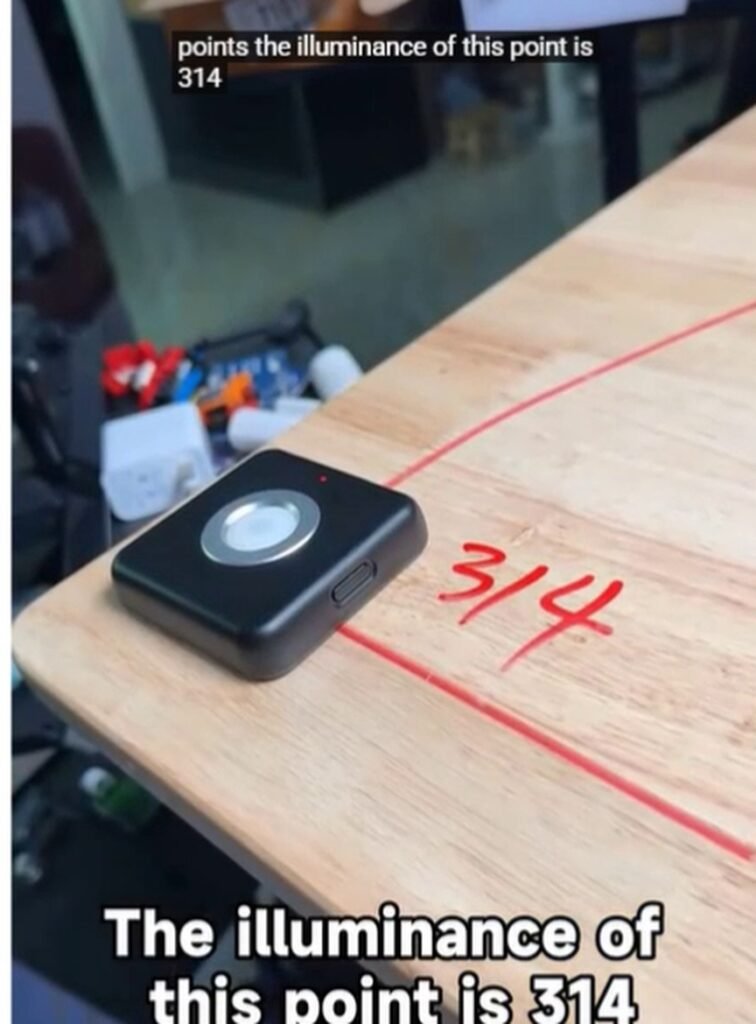
One measured position farther from the brightest area recorded approximately 314 lux.among the points shown in the video.
The center reading was approximately:
910 lux.
We then defined a:
50 × 30 cm
writing area and measured:
15 separate positions.
The app calculated:
758.333 lux average illuminance
and:
0.79 illuminance uniformity.
These measurements provide a much more complete description of the lamp’s desk-level lighting than a single brightness reading.
What This Test Does Not Prove
This test does not prove that:
- every wide-area study floor lamp will perform the same way;
- these readings apply at every brightness setting;
- the results would remain identical at another lamp height;
- one lux number can fully describe visual comfort;
- higher lux always means better lighting;
- the test alone evaluates glare, flicker or color rendering;
- the measured lamp automatically complies with every international lighting standard.
Those require separate measurements or standards-specific test procedures.
Frequently Asked Questions
What should this type of lamp be called in English?
For this style of large standing lamp designed to illuminate an entire reading and writing desk, wide-area study floor lamp is a clear descriptive term.
It distinguishes the product from an outdoor street light and from a small conventional desk lamp.
How many lux are useful for reading and writing?
There is no single number that applies to every situation. International workplace lighting guidance commonly uses approximately 500 lux for reading and writing task areas, but requirements vary by country, environment and activity. IEA reading and writing illuminance guidance
Why measure more than one point?
Because illumination changes across the surface. One center measurement cannot show how bright or dark the surrounding parts of the desk are.
What was the center illuminance in this test?
Approximately 910 lux.
What was the average illuminance across the 50 × 30 cm test area?
The app calculated approximately 758.333 lux.
What was the measured illuminance uniformity?
The 15-point distribution test reported a uniformity value of approximately 0.79.
Why use a 15-point grid?
A multi-point grid provides a better picture of lighting distribution across a working area than a single measurement.
Does this test measure glare or flicker?
No. This particular test focuses on desk-level illuminance and illuminance distribution. Glare, flicker and other lighting-quality characteristics require additional evaluation.
Test Conclusion
A study lamp should not be evaluated by its brightest point alone.
In this real-world test, the AH-300 measured illuminance at multiple locations beneath a wide-area study floor lamp.
The individual values shown ranged from approximately:
314 to 954 lux,
with approximately:
910 lux
at the center point.
Across a defined:
50 × 30 cm
reading and writing area, the 15-point test produced:
758.333 lux average illuminance
and:
0.79 illuminance uniformity.
The result demonstrates why multi-point measurement is useful when evaluating large-area study lighting.
It allows us to move beyond:
“This lamp looks bright.”
and answer the more useful question:
“How much light reaches the desk, and how evenly is that light distributed?”
Test Information
Meter: AquaHorti AH-300
Light type: Wide-area study floor lamp
Application: Reading and writing desk lighting
Initial geometry: 30 cm and 50 cm semicircular reference areas
Center illuminance: approximately 910 lux
Individual readings shown: 314–954 lux
Distribution test area: 50 × 30 cm
Measurement grid: 5 × 3 / 15 points
Average illuminance: 758.333 lux
Illuminance uniformity: 0.79
Original video date: March 12, 2025