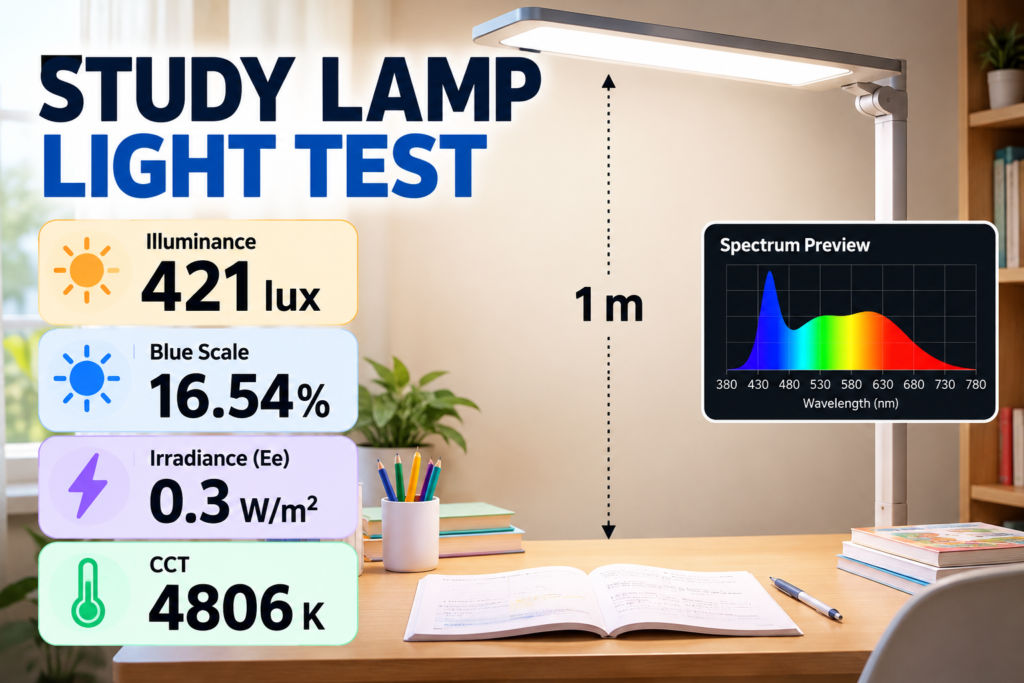
Floor-standing study lamps are designed to illuminate a large desk area for reading, writing and homework. But what does the light actually look like when measured?
We performed a practical measurement of a large floor-standing study lamp, with the sensor positioned approximately 1 meter below the lamp head.
Short answer: under the conditions shown in this test, the meter measured approximately 421 lux, with a 16.54% Blue Scale reading, 0.3 W/m² irradiance (Ee) and a CCT of 4806 K.
These values describe one measurement point under this specific setup. They do not by themselves determine whether the lamp provides suitable lighting across an entire study desk.
Watch the Original Test
The original AquaHorti test video was published on April 4, 2025.
How Was the Study Lamp Tested?
The test used a large floor-standing LED study lamp designed to illuminate a desk from above.
The light sensor was positioned approximately 1 meter below the lamp head.
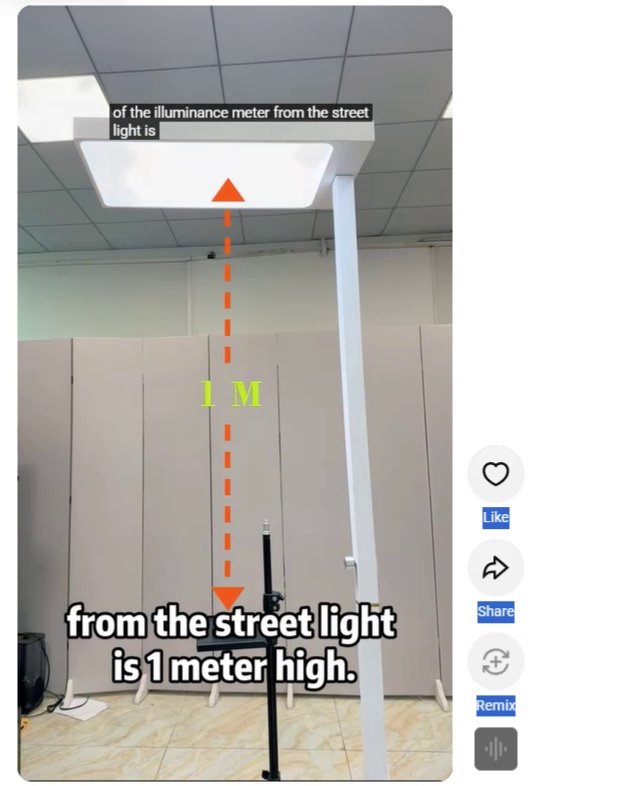
This provided a simple point measurement of the light reaching the sensor directly below the illuminated area.
Keeping the measurement position and distance consistent is important because lux can change significantly when the sensor is moved closer to, farther from, or away from the center of the illuminated area.
What Did the Meter Show?
The measurement screen displayed approximately:
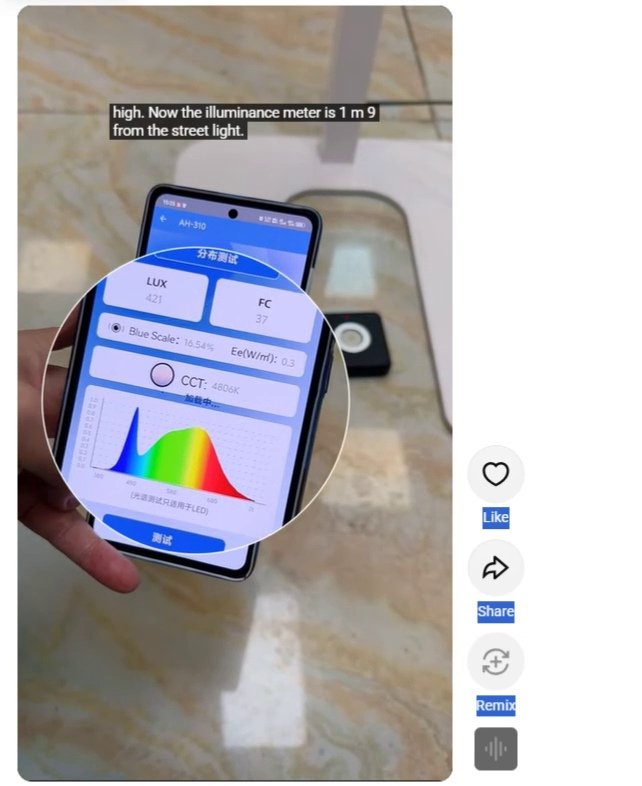
| Measurement | Reading shown in the video |
|---|---|
| Illuminance | 421 lux |
| Blue Scale | 16.54% |
| Irradiance (Ee) | 0.3 W/m² |
| CCT | 4806 K |
| Measurement distance | ≈ 1 m |
The App also displayed 37 fc in the captured frame.
Because 421 lux is approximately 39.1 fc, the displayed lux and foot-candle values in that frame are not exact unit equivalents. For this article, 421 lux is used as the primary illuminance reading, and the displayed 37 fc value is not used for calculations.
Test result
At approximately 1 meter below the lamp head, the study lamp produced about 421 lux at the measurement point.
The measurement also showed a CCT of approximately 4806 K and a measurable blue-region component in the spectrum preview.
What Does 421 Lux Mean for a Study Lamp?
Lux describes the amount of visible light reaching a surface or measurement point.
In this test, 421 lux was measured at one position below the lamp.
It does not tell us how evenly the entire desk is illuminated.
A large study lamp may produce different readings at the:
- center of the desk,
- left and right sides,
- front edge,
- rear edge,
- and corners.
For a reading-and-writing setup, measuring several points across the working surface provides much more useful information than relying on a single lux value.
Why Does the 1-Meter Measurement Distance Matter?
Illuminance depends strongly on the distance and geometry between the lamp and the measurement surface.
Moving the sensor closer to the lamp will generally increase the measured lux, while moving it farther away can reduce the reading.
The 421 lux result therefore applies only to the measurement position shown in this video.
It should not be interpreted as a fixed brightness specification for the lamp at every desk height or installation position.
What Does the 4806 K CCT Mean?
The measured correlated color temperature was approximately 4806 K.
CCT describes the overall appearance of nominally white light.
A value around 4800 K appears more neutral-to-cool than warm residential lighting.
However, CCT alone does not describe the complete spectral distribution of a light source.
Two lamps with similar CCT values can still have different spectral characteristics.
What Does the 16.54% Blue Scale Reading Mean?
The App displayed a Blue Scale reading of approximately 16.54%.
This value is useful primarily as a comparative measurement parameter.
For example, the same study lamp could be tested under different:
- brightness levels,
- color-temperature settings,
- measurement distances,
- or lighting modes.
If the other test conditions remain unchanged, changes in Blue Scale can help show how the spectral balance has changed.
The value should not be interpreted as a health-risk percentage or an eye-safety rating.
What Does 0.3 W/m² Irradiance Mean?
The App displayed an irradiance value, Ee, of approximately 0.3 W/m².
Irradiance describes optical power reaching a unit area at the sensor position.
Like lux, it depends on the position of the sensor, distance from the lamp and light distribution.
The 0.3 W/m² value therefore describes this particular measurement setup rather than a universal output value for the lamp.
Is 421 Lux Enough for Reading and Writing?
A single point measurement cannot fully answer that question.
The measured 421 lux shows how much illuminance reached one location in this test, but a study desk should also be evaluated for how evenly the light is distributed across the working area.
Other factors can also matter, including:
- illuminance uniformity,
- glare,
- flicker,
- shadows,
- lamp position,
- and the size of the illuminated area.
For this reason, the test should be treated as a lighting measurement, not as a certification that the lamp is suitable for children’s study or long-term visual comfort.
Why Is Uniformity Important for a Large Study Lamp?
One of the main purposes of this type of floor-standing study lamp is to illuminate a relatively large desk area.
If the center of the desk is bright but the sides are much darker, one center-point lux measurement can hide that difference.
A more useful test would measure several positions across the desk, such as:
Center → Left → Right → Front → Back
The results could then be compared to understand both average illumination and uniformity.
A Better Study-Desk Lighting Test
For a more complete evaluation, keep the lamp position and brightness setting unchanged and measure several points across the desk.
For example:
| Position | Measurement |
|---|---|
| Center | Lux |
| Left | Lux |
| Right | Lux |
| Front | Lux |
| Back | Lux |
The same test can also record CCT and other lighting parameters at each position.
This type of multi-point measurement provides a much clearer picture of how the lamp performs across the actual reading and writing area.
Test Limitations
This was a practical demonstration rather than a standardized reading-and-writing lamp evaluation.
The test measured only one main position and did not map illuminance across the entire desk surface.
It also did not evaluate:
- illuminance uniformity,
- glare,
- flicker,
- color rendering,
- long-term visual comfort,
- or compliance with any specific reading-light standard.
The 421 lux result should therefore be interpreted as a point measurement under the conditions shown in the video, not as a complete assessment of the lamp’s suitability for children’s study.
Related Lighting Measurement Tests
For another real-world lighting test, see our 55W Halogen vs 7W LED: Lux and Power Comparison Test.
You can also see our Does LED Brightness Decrease Over Time? 2-Year vs 6-Month Lux Test.
About the Meter Shown in the Video
The original 2025 video shows AH-310 in the app interface.
AquaHorti’s current indoor-light measurement product is AH-300, which supports LUX/FC, CCT and additional lighting measurements.
Learn more: AH-300 Light Meter – LUX, CCT & Blue-Light Measurementhttps://aquahorti.com/ah-300/
Frequently Asked Questions
What type of lamp was tested?
The video tested a large floor-standing study lamp designed to illuminate a desk for reading, writing and homework.
How bright was the study lamp in this test?
The meter measured approximately 421 lux at a position about 1 meter below the lamp head.
What was the measured color temperature?
The measured CCT was approximately 4806 K.
What was the Blue Scale reading?
The App displayed approximately 16.54% Blue Scale under the test conditions shown in the video.
Is 421 lux enough for a child’s study desk?
A single lux measurement cannot determine that by itself. Lighting across the entire working surface, including uniformity and other characteristics, should also be considered.
Can one measurement determine whether a study lamp is good for the eyes?
No. A light meter can measure optical characteristics such as illuminance and CCT, but one measurement cannot establish eye-health benefits or long-term visual comfort.