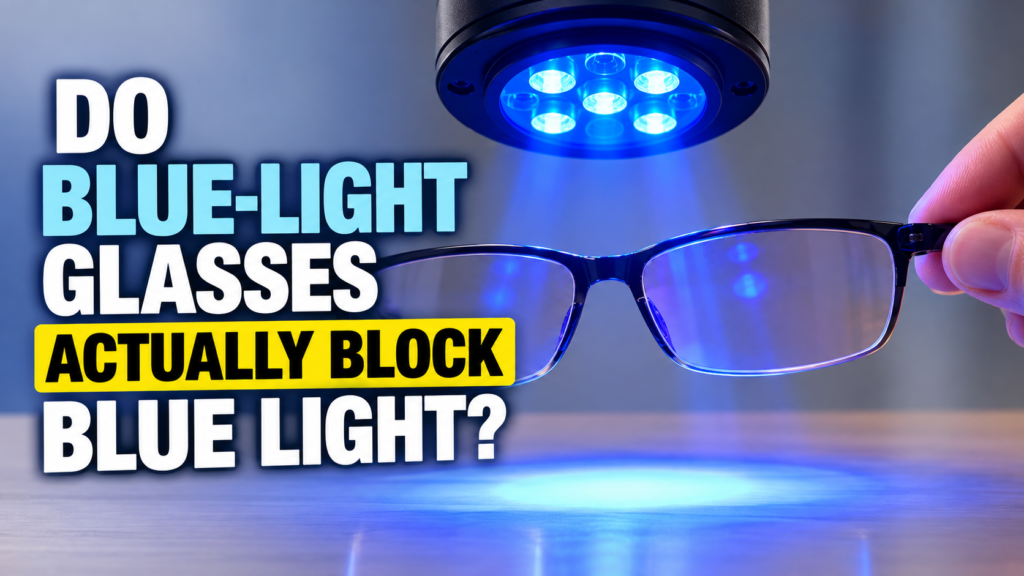
Blue-light-blocking glasses are often marketed as a way to reduce blue light reaching the eyes. But how much blue light does a particular pair of glasses actually block?
We performed a simple comparison test using a blue LED light source and an AquaHorti light meter.
Short answer: in this test, the pair of glasses we tested did not produce a meaningful reduction in the measured blue-light level.
This result applies only to the glasses, light source and measurement setup shown in this test. It should not be interpreted as a statement about every pair of blue-light-filtering glasses.
Watch the Original Test
The original AquaHorti test video was published on March 25, 2025.
How Was the Blue-Light Glasses Test Performed?
The test used a blue LED source positioned above the light sensor.
First, the light was measured directly without the glasses covering the sensor.
The glasses were then placed between the light source and the sensor, while the light source and meter remained in approximately the same positions.
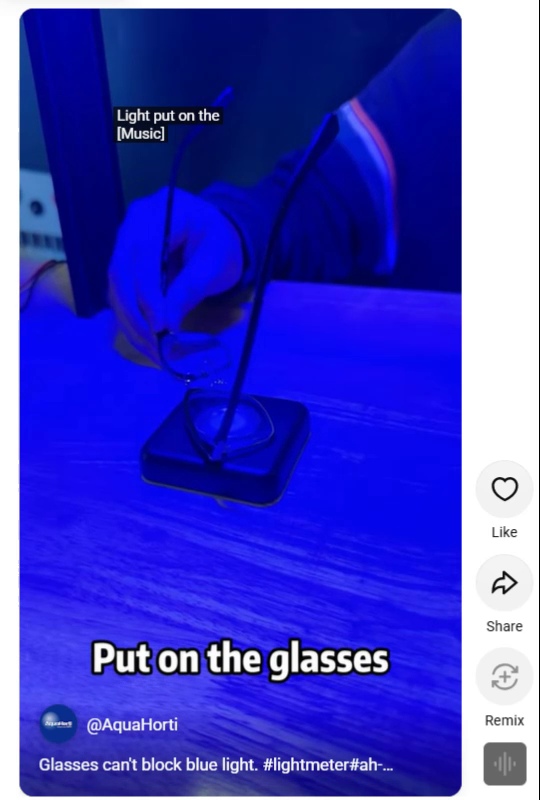
This makes it possible to compare the blue-light measurement before and after the lens is introduced.
The important question is simple:
Does placing the lens in the optical path cause the measured blue-light level to decrease?
What Did the Meter Show?
During the test, the measurement screen showed approximately:
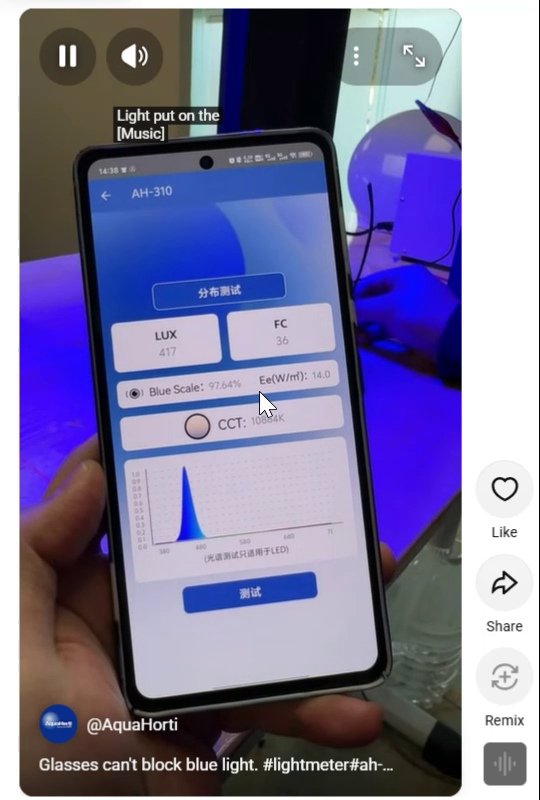
| Measurement | Reading shown in the test |
|---|---|
| Illuminance | 428 lux |
| Foot-candles | 37 fc |
| Blue Scale | 97.39% |
| Blue-light irradiance | 13.4 W/m² |
| CCT displayed by the app | 10,884 K |
After the glasses were placed over the sensor, the blue-light reading remained essentially unchanged at the resolution visible in the video.
The spectrum preview also remained strongly concentrated in the blue region.
Test result
This particular pair of glasses did not show a meaningful blue-light reduction under this test condition.
That is different from saying that all glasses marketed for blue-light filtering behave the same way.
Why Measure the Light Instead of Judging the Lens by Color?
A lens may look slightly yellow, amber, gray or clear, but appearance alone does not tell us exactly how much optical energy it transmits at a particular wavelength.
A measurement makes the comparison more objective.
For a basic before-and-after check, the most useful approach is to keep these conditions unchanged:
- the same light source,
- the same source-to-sensor distance,
- the same sensor position,
- the same measurement mode,
- and then compare the reading with and without the lens.
If the lens strongly attenuates the tested blue wavelength, the measured blue-light irradiance should decrease.
Does This Mean Blue-Light Glasses Do Not Work?
No.
This experiment tested one pair of glasses under one blue-light source.
Different lenses may use different coatings, materials or spectral filtering characteristics. Their transmission can also vary considerably across different wavelengths.
For that reason, this test should be interpreted as:
“These glasses did not show significant blue-light attenuation under the conditions used in this test.”
It should not be interpreted as:
“All blue-light glasses are ineffective.”
What Is the Best Way to Test Blue-Light Filtering?
For a practical comparison, a light meter capable of measuring blue-light irradiance can be used to compare the same source before and after light passes through the lens.
For more detailed optical characterization, a spectrometer can measure the lens transmission at individual wavelengths and produce a wavelength-by-wavelength transmission curve.
That type of measurement is more appropriate when a precise spectral transmission specification is required.
A Note About the Meter Shown in the Video
The original 2025 video shows AH-310 in the app interface.
AquaHorti’s current indoor-light measurement product is the AH-300, which measures LUX/FC, CCT, blue-light irradiance and blue-light percentage and provides additional lighting-measurement functions.
Learn more:
AH-300 Light Meter – LUX, CCT & Blue-Light Measurement
Frequently Asked Questions
Did the glasses in this video block blue light?
No meaningful reduction was visible in the meter reading after this particular pair of glasses was placed between the blue LED source and the sensor.
Does this test prove that all blue-light glasses are ineffective?
No. The result applies only to the glasses, light source and measurement conditions used in this experiment.
How can I test whether glasses reduce blue light?
Measure the same blue-light source with the sensor in a fixed position, record the baseline blue-light irradiance, place the lens between the source and sensor, and measure again. A reduction in irradiance indicates attenuation under that specific test condition.
Can lens color alone tell me how much blue light is blocked?
Not reliably. The visible color of a lens does not provide a quantitative measurement of wavelength-dependent transmission.
Is this a medical or eye-safety test?
No. This is an optical measurement comparison. It is not a medical diagnosis, eye-safety certification or clinical evaluation.