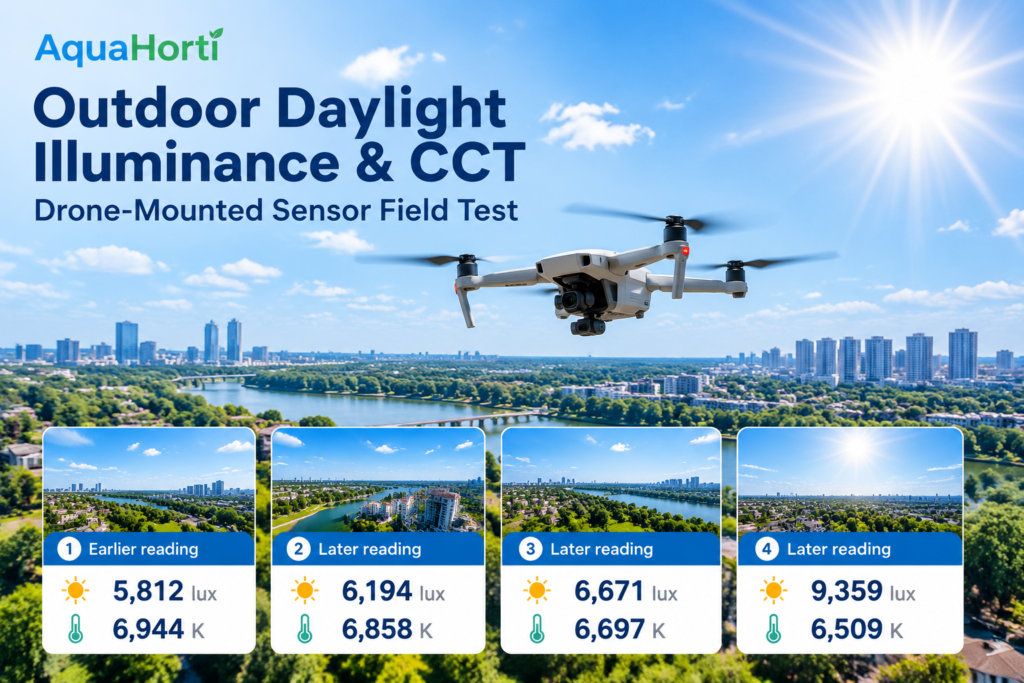
Outdoor daylight is not a fixed light source.
Its measured illuminance and correlated color temperature can change as measurement position, sensor orientation, sky conditions and surrounding objects change.
To demonstrate this in a real outdoor environment, we mounted a light sensor on a small drone and viewed the live measurements remotely while the drone was flying.
Short answer: during the short field test shown in the video, visible illuminance readings ranged from approximately 5,812 lux to 9,359 lux, while the displayed CCT values ranged from approximately 6,944 K to 6,509 K.
These values describe several moments during this specific outdoor test. They should not be interpreted as a controlled altitude experiment.
Watch the Original Outdoor Light Test
The original AquaHorti test video was published on April 9, 2025.
How Was the Outdoor Light Test Performed?
A light sensor was mounted on top of a small drone with the sensing surface facing upward.
The drone was then flown outdoors while live measurement data were viewed on a smartphone.
This setup made it possible to observe changes in outdoor illuminance and CCT while the sensor moved through different positions in the open environment.
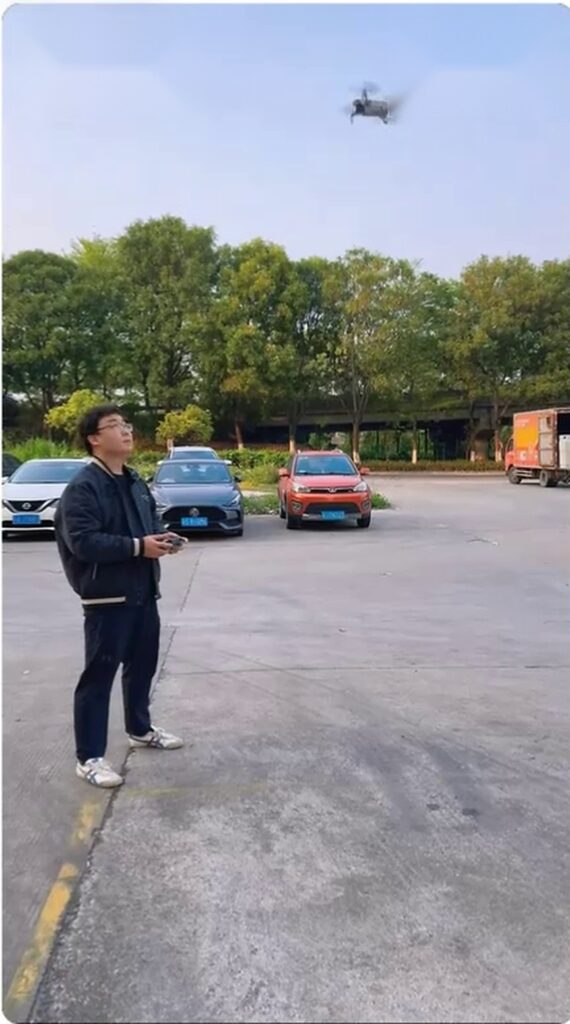
The video was intended as a practical field demonstration rather than a controlled laboratory experiment.
What Did the Meter Show?
Several clearly visible readings during the flight included:
| Measurement moment | Illuminance | CCT |
|---|---|---|
| Reading 1 | 5,812 lux | 6,944 K |
| Reading 2 | 6,194 lux | 6,858 K |
| Reading 3 | 6,671 lux | 6,697 K |
| Reading 4 | 9,359 lux | 6,509 K |
Across these visible readings, illuminance changed by more than 3,500 lux.
The CCT readings also changed by several hundred kelvins during the short outdoor measurement.
Test result
The outdoor light measured by the moving sensor was not constant.
The visible readings changed from approximately:
5,812 lux / 6,944 K
to as high as:
9,359 lux / 6,509 K
during the short field test.
This does not prove that altitude alone caused the change.
What Does Outdoor Illuminance Mean?
Illuminance describes the amount of visible light reaching a surface or sensor and is measured in lux.
Outdoor illuminance can change rapidly because the sensor may receive different amounts of:
- direct sunlight,
- diffuse skylight,
- reflected light from buildings,
- ground reflections,
- and light blocked by surrounding objects.
Even over a short period, movement through an outdoor environment can therefore produce noticeably different lux readings.
Why Did the Lux Reading Change During the Flight?
Several factors could have contributed.
Sensor position
The drone was moving rather than remaining at one fixed measurement point.
Different positions can expose the sensor to different amounts of open sky and reflected light.
Sensor orientation
Small changes in drone pitch, roll or yaw can change the angle between the sensor and the incoming daylight.
That can affect the measured illuminance.
Buildings and surrounding surfaces
The test took place near buildings, vehicles and paved surfaces.
These objects can block or reflect daylight and change the amount of light reaching the sensor.
Outdoor sky conditions
Natural daylight is inherently variable.
Changes in cloud cover, atmospheric conditions and the sun’s position can all affect measured illuminance.
For these reasons, the difference between 5,812 lux and 9,359 lux should be treated as a field-observation range, not as an altitude-response curve.
What Does the CCT Reading Tell Us?
CCT stands for Correlated Color Temperature and is expressed in kelvins.
It describes the overall color appearance of nominally white light.
In this test, the visible outdoor CCT readings were approximately:
6,944 K → 6,858 K → 6,697 K → 6,509 K
These values are consistent with relatively cool-looking daylight.
The U.S. Department of Energy describes CCT as a primary metric used to characterize the visual color appearance of light. The Department of Energy’s Energy.gov
Why Can Outdoor CCT Change?
Natural daylight color is not constant.
The relative contributions of direct sunlight, blue sky light and reflected light from nearby surfaces can change depending on:
- time of day,
- weather,
- cloud conditions,
- sensor direction,
- and surrounding buildings.
Historical NIST daylight research also notes that daylight color characteristics vary with time, season and weather conditions. NIST 技术系列出版物
That means a single outdoor CCT measurement should be treated as a measurement of that particular place and moment.
Does Higher Lux Mean Higher CCT?
Not necessarily.
Illuminance and CCT describe different characteristics of light.
Lux tells us how much visible light reaches the sensor.
CCT describes the overall color appearance of that light.
A brighter outdoor reading does not automatically mean a higher or lower CCT.
In this video, lux generally increased across the selected readings while CCT decreased somewhat, but the experiment did not control enough variables to establish a causal relationship between the two.
Can This Test Show How Daylight Changes With Altitude?
No.
The video does not record precise drone altitude at each measurement point.
It also does not keep sensor orientation, position relative to buildings or sky exposure strictly controlled.
Therefore, the data should not be used to claim:
“Lux increases with altitude”
or:
“CCT decreases with altitude.”
A proper altitude study would require the same sensor orientation, recorded altitude, repeated measurements and controlled timing.
How Could a Better Outdoor Height Test Be Performed?
A more rigorous experiment could record measurements at fixed heights, for example:
1 m → 5 m → 10 m → 20 m
At each height, the test should keep the sensor:
- level,
- facing the same direction,
- away from nearby obstructions,
- and at each position long enough for readings to stabilize.
The exact time, weather and sky condition should also be recorded.
This would make it possible to evaluate whether measurement height had a repeatable effect.
Why Use a Remote Sensor for Outdoor Measurements?
Some measurement positions are difficult to reach safely from the ground.
A lightweight remote sensor can make it possible to collect light data from positions such as:
- above a roofline,
- near elevated structures,
- above vegetation,
- or other inaccessible outdoor locations.
However, any moving platform introduces additional variables, especially sensor orientation and position.
For quantitative work, those variables need to be controlled and documented.
Test Limitations
This was a practical outdoor demonstration rather than a standardized daylight measurement study.
The test did not document:
- exact drone altitude at each reading,
- fixed sensor orientation,
- solar position,
- cloud cover,
- measurement stabilization time,
- repeated measurements at identical positions,
- or a calibrated reference instrument operating alongside the sensor.
The readings should therefore be interpreted as real-time illuminance and CCT observations during one short outdoor flight, not as universal daylight values or an altitude-dependent lighting model.
What Is the Most Useful Takeaway?
The main takeaway is simple:
Outdoor daylight measurements can change significantly even during a short field test.
In the visible readings from this video:
- illuminance ranged from approximately 5,812 to 9,359 lux
- CCT ranged from approximately 6,944 to 6,509 K
For meaningful outdoor lighting comparisons, measurement position, orientation, time and environmental conditions should be recorded as carefully as possible.
Related Lighting Measurement Tests
For an indoor lighting-position example, see our How Bright Is a Floor-Standing Study Lamp? Lux & CCT Test.
You can also see our LED Color Temperature Accuracy Test: 2700K–6000K, which compares nominal and measured CCT values under controlled indoor conditions.
About the Meter Shown in the Video
The original 2025 video shows AH-310 in the app interface.
AquaHorti’s current indoor-light measurement product is AH-300, which supports illuminance and correlated color temperature measurements.
Learn more: AH-300 Light Meter – LUX & CCT Measurement
Frequently Asked Questions
What was the outdoor illuminance measured in this test?
Several visible readings ranged from approximately 5,812 lux to 9,359 lux during the short drone flight.
What color temperature was measured outdoors?
The visible CCT readings ranged from approximately 6,944 K to 6,509 K.
Did higher altitude cause the lux reading to increase?
This test cannot establish that. Exact altitude and sensor orientation were not recorded for each measurement.
Why can outdoor lux change so quickly?
Sensor position, orientation, direct sunlight, diffuse sky light, shadows and reflections from surrounding objects can all change the amount of light reaching the sensor.
Does higher lux mean a higher color temperature?
No. Illuminance and CCT describe different properties of light and do not have a fixed relationship.
Can a drone-mounted sensor be used for precise daylight research?
It can be useful for field measurements, but precise research requires controlled orientation, known altitude, repeatable positions and documented environmental conditions.