Beam angle can have a major effect on how concentrated or spread out a light appears.
But how much can the measured illuminance change when different LED beam angles are tested at the same height?
We performed a practical comparison using an LED angle test bar with several different beam-angle optics. The sensor position and test height were kept similar while each beam was measured.
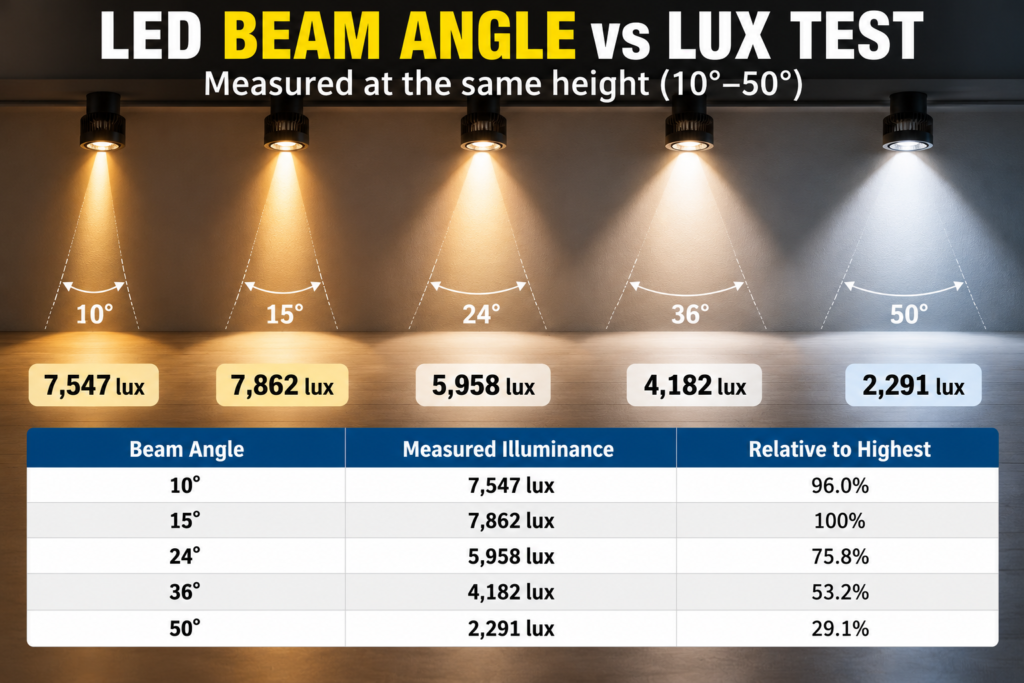
Short answer: the measured center illuminance ranged from 7,862 lux at 15° to 2,291 lux at 50°. In this setup, the 50° beam produced about 71% less center illuminance than the highest reading recorded at 15°.
The test also showed that beam angle alone does not completely determine the lux reading: the 10° beam measured slightly lower than the 15° beam.
Watch the Original Beam-Angle Test
The original AquaHorti test video was published on April 7, 2025.
What Was Tested?
The video uses an LED angle test bar fitted with different optical beam angles.
Five beam angles were measured:
10°, 15°, 24°, 36° and 50°.
The light meter was placed at approximately the same height and measurement position for each test.
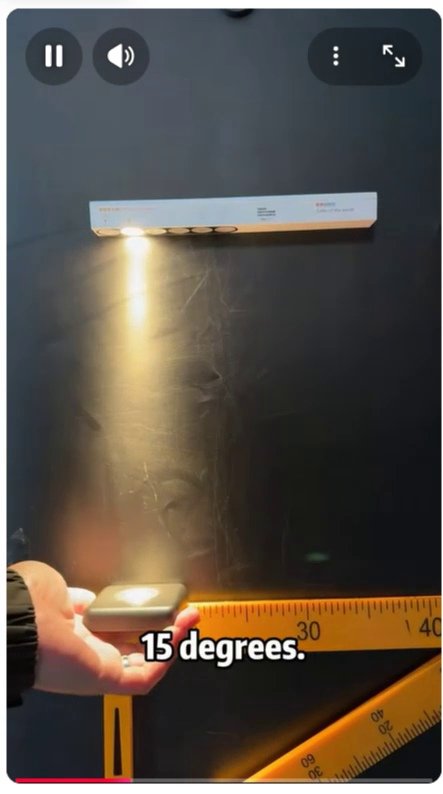
This makes it possible to compare how the different optical beam distributions affected the illuminance reaching the sensor.
What Did the Meter Measure?
The readings shown in the video were:
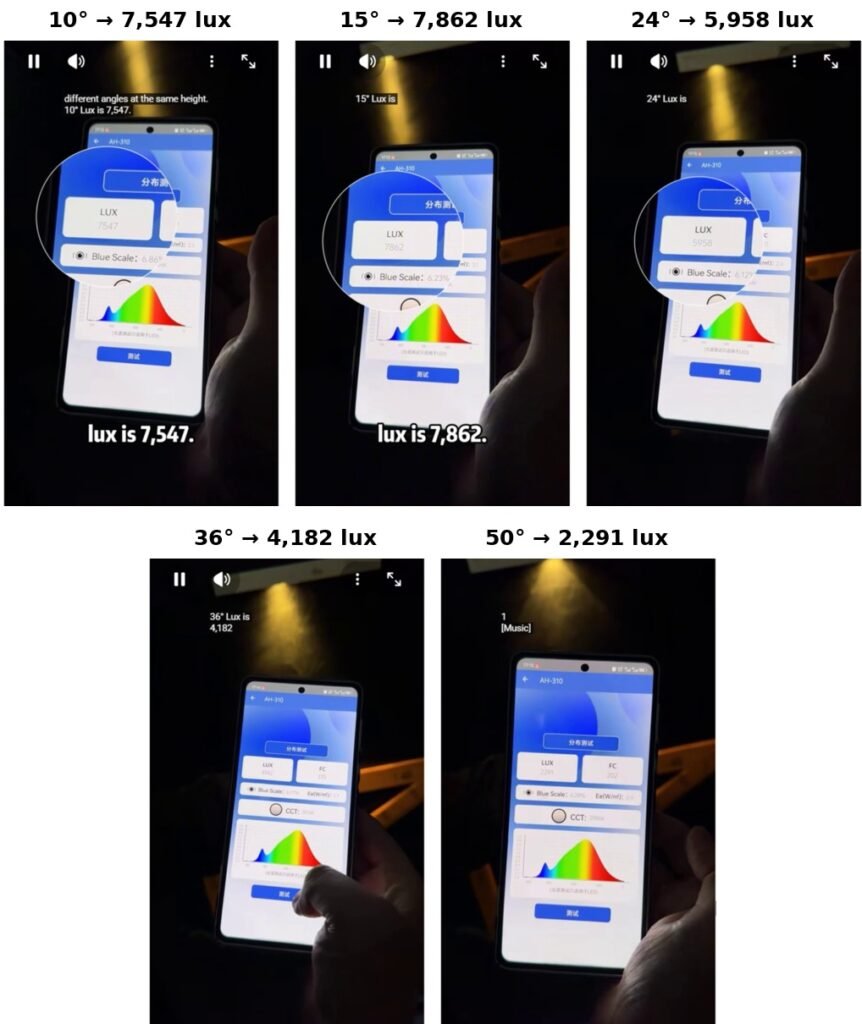
| Beam angle | Measured illuminance | Relative to highest reading |
|---|---|---|
| 10° | 7,547 lux | 96.0% |
| 15° | 7,862 lux | 100% |
| 24° | 5,958 lux | 75.8% |
| 36° | 4,182 lux | 53.2% |
| 50° | 2,291 lux | 29.1% |
Test result
The wider beam angles generally produced lower center-point illuminance in this test.
The highest measured value was:
15° → 7,862 lux
The lowest measured value was:
50° → 2,291 lux
That means the 50° beam produced approximately 70.9% less center illuminance than the 15° beam at the test point.
Why Does Beam Angle Affect Lux?
A narrower beam generally concentrates more of the emitted light into a smaller area.
A wider beam spreads the light across a larger area.
Because lux measures the amount of visible light reaching a particular surface area, concentrating light into a smaller region can produce a higher center lux reading.
The Illuminating Engineering Society defines beam angle using the directions where luminous intensity falls to 50% of the maximum beam intensity.
However, beam angle does not tell us everything about a light source.
Two lights with the same nominal beam angle can still produce different center lux readings because of differences in LED output, optics, alignment and beam shape.
Why Did the 15° Beam Measure Higher Than the 10° Beam?
The 10° beam measured:
7,547 lux
while the 15° beam measured:
7,862 lux
That is approximately 4.2% higher for the 15° sample.
This is an important result because it shows that real-world measurements do not always follow a perfectly simple “narrower angle = higher lux” pattern.
Possible factors include:
- different optical transmission efficiency,
- small LED output differences,
- sensor alignment,
- beam-center alignment,
- lens manufacturing variation,
- and differences in the shape of the light distribution.
For this reason, beam angle should be treated as one optical characteristic, not as a direct predictor of exact lux output.
How Much Did Lux Drop as the Beam Became Wider?
Using the 15° reading as the highest measured value:
- 15°: 7,862 lux
- 24°: 5,958 lux — about 24.2% lower
- 36°: 4,182 lux — about 46.8% lower
- 50°: 2,291 lux — about 70.9% lower
The trend becomes especially clear between 24° and 50°.
As the beam spread increased, less light was concentrated at the center measurement point.
Does a Higher Lux Reading Mean More Total Light?
No.
Lux measures illuminance at a particular position.
A narrow beam can create a high lux value at the center while illuminating a relatively small area.
A wider beam may produce a lower center lux value but cover a much larger area.
Therefore, a higher center lux reading does not automatically mean the light source produces more total lumens.
This distinction is important when comparing spotlights, track lights, display lights and other directional lighting.
Narrow Beam vs Wide Beam: Which Is Better?
Neither is universally better.
The correct beam angle depends on what the light is intended to do.
Narrow beam
A narrow beam can be useful when you want to:
- highlight a small object,
- illuminate a display,
- create an accent-lighting effect,
- or deliver higher center illuminance from a fixed position.
Wide beam
A wider beam can be useful when you want to:
- illuminate a larger working area,
- reduce concentrated hot spots,
- cover shelves or walls more evenly,
- or create broader general illumination.
The most suitable beam angle therefore depends on both target size and required illuminance.
Why Is Test Distance Important?
Beam angle and distance work together.
As the light travels farther from the source, the illuminated area becomes larger.
That means a 15° beam measured at a short distance will cover a much smaller area than the same 15° beam measured farther away.
Illuminance also changes with distance.
For meaningful beam-angle comparisons, the measurement height and sensor position should therefore remain as consistent as possible.
Is This the Same as the Cosine Law?
Not exactly.
The cosine law describes how illuminance on a surface changes when light strikes that surface at different angles of incidence. The IES expresses this relationship as illuminance varying with the cosine of the incidence angle. Illuminating Engineering Society
This experiment is different.
Here, the main variable is the beam angle of different optics, while the measurement geometry is kept approximately similar.
So the results should not be interpreted as a direct experimental verification of the cosine law.
Why Beam Angle Matters in Real Lighting Design
Beam angle can substantially affect how a fixture performs in a real installation.
For example, two fixtures with similar electrical power and lumen output can create very different lighting conditions if one uses a narrow optic and the other uses a wide optic.
A narrow beam may produce:
higher center lux + smaller illuminated area
while a wider beam may produce:
lower center lux + larger illuminated area
For applications such as retail displays, museums, galleries, shelves, furniture showrooms and architectural accent lighting, beam distribution can be just as important as wattage or total lumen output.
A Better Beam-Angle Test
A more complete comparison would measure more than just the center point.
For each beam angle, a grid of lux measurements could be taken across the illuminated area.
For example:
Center → Left → Right → Front → Back
This would make it possible to compare:
- peak illuminance,
- average illuminance,
- illuminated area,
- beam uniformity,
- and edge falloff.
A full photometric test would provide even more detailed luminous-intensity distribution data.
Test Limitations
This was a practical comparison rather than a standardized laboratory photometric test.
The test did not document:
- total luminous flux for each LED,
- calibrated luminous intensity,
- exact beam-angle verification,
- optical transmission efficiency,
- full illuminance distribution,
- integrating-sphere measurements,
- or an IES photometric file.
The labeled beam angles were treated as the nominal optical angles of the samples used in the angle test bar.
The results should therefore be interpreted as center-point lux measurements from these specific samples under the conditions shown in the video, not as universal lux values for all 10°, 15°, 24°, 36° or 50° LED optics.
What Is the Most Useful Takeaway?
This test demonstrates an important lighting principle:
Beam angle changes how light is distributed, and that can strongly affect center-point lux.
In this test:
15° → 7,862 lux
24° → 5,958 lux
36° → 4,182 lux
50° → 2,291 lux
But the 10° result was slightly lower than the 15° result, showing that beam angle is not the only variable controlling measured illuminance.
For real lighting projects, the best approach is to choose the beam angle based on both:
how much area needs to be illuminated
and
how much illuminance is needed within that area.
Related Lighting Measurement Tests
For another test showing how lighting geometry affects measured illuminance, see our How Bright Is a Floor-Standing Study Lamp? Lux, CCT & Blue-Light Test.
You can also see our 55W Halogen vs 7W LED: Lux and Power Comparison Test for a comparison of electrical rating and measured illuminance.
About the Meter Shown in the Video
The original 2025 video shows AH-310 in the app interface.
AquaHorti’s current indoor-light measurement product is AH-300, which supports LUX/FC, CCT and additional lighting measurements.
Learn more: AH-300 Light Meter – LUX, CCT & Blue-Light Measurement
Frequently Asked Questions
Does a narrower LED beam always produce higher lux?
No. A narrower beam often concentrates light into a smaller area, but actual center lux also depends on LED output, optical efficiency, alignment and beam distribution.
Which beam angle produced the highest lux in this test?
The 15° beam produced the highest measured reading at approximately 7,862 lux.
What did the 10° beam measure?
The 10° beam measured approximately 7,547 lux.
What did the 50° beam measure?
The 50° beam measured approximately 2,291 lux, about 70.9% lower than the highest reading measured at 15°.
Does a wider beam produce less total light?
Not necessarily. A wider beam spreads light over a larger area. A lower center lux reading does not by itself mean lower total lumen output.
Can lux tell us the beam angle?
No. Beam angle describes the angular distribution of light, while lux measures illuminance at a particular position. A single lux value cannot determine beam angle.