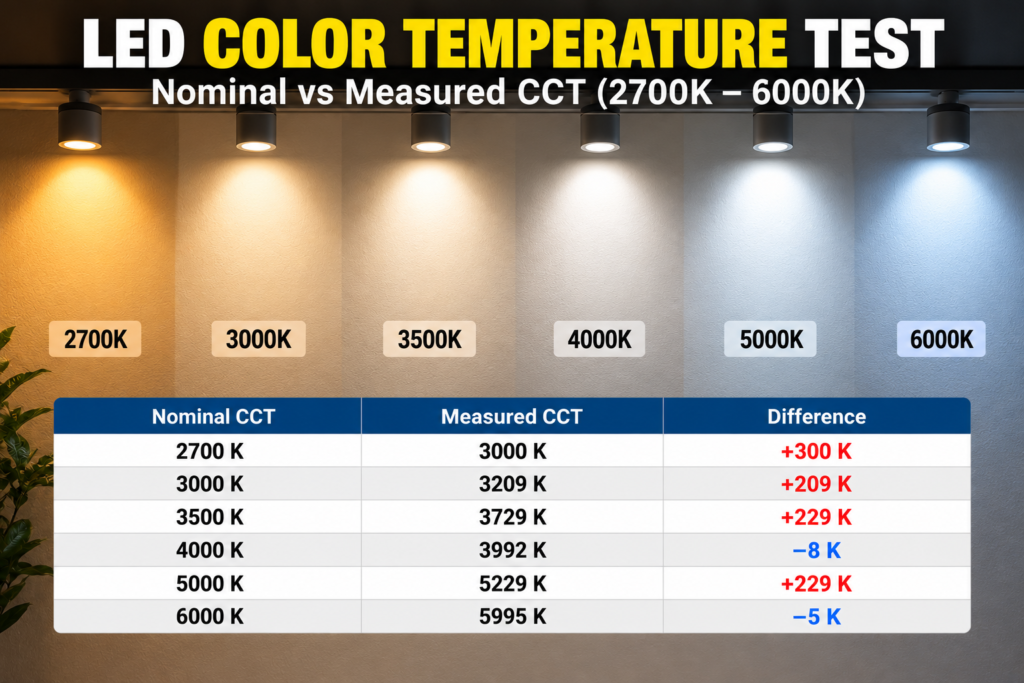
LED products are commonly labeled with color temperatures such as 2700K, 3000K, 4000K or 5000K.
But does the actual measured correlated color temperature always match the number printed on the product?
We tested six LED color-temperature samples labeled from 2700K to 6000K and measured their actual CCT with a light meter.
Short answer: the measured values were reasonably close to the nominal labels, but they were not always identical. In this test, the largest difference was 300K, while the 4000K and 6000K samples measured almost exactly at their nominal values.
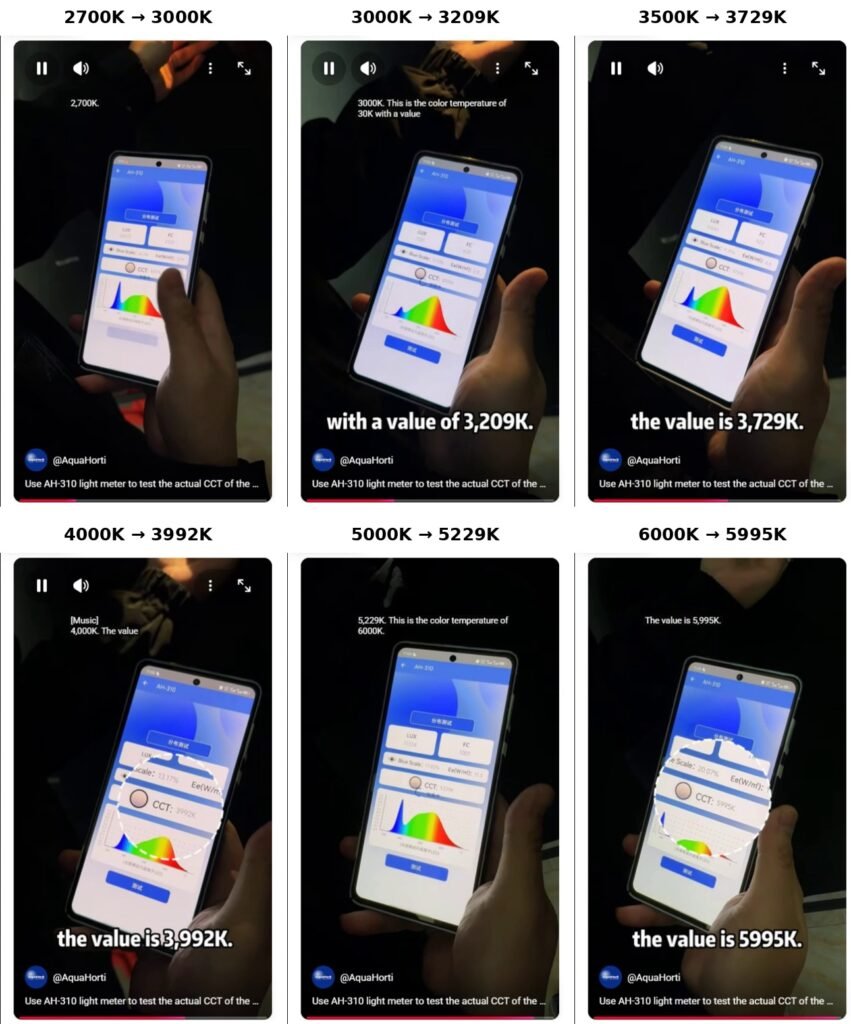
Watch the Original CCT Test
The original AquaHorti test video was published on April 6, 2025.
What Color Temperatures Were Tested?
The test used an LED color-temperature comparison bar containing multiple LED samples with different nominal CCT values.
Six settings were measured:
2700K, 3000K, 3500K, 4000K, 5000K and 6000K.
Each LED sample was illuminated individually, and the sensor was positioned in the light to measure its actual correlated color temperature.
The same measurement method was used across the samples to make the comparison easier to interpret.

What Did the Meter Measure?
The results shown in the video were:
| Nominal CCT | Measured CCT | Difference |
|---|---|---|
| 2700 K | 3000 K | +300 K |
| 3000 K | 3209 K | +209 K |
| 3500 K | 3729 K | +229 K |
| 4000 K | 3992 K | −8 K |
| 5000 K | 5229 K | +229 K |
| 6000 K | 5995 K | −5 K |
Across these six samples, the average absolute difference between the nominal and measured values was approximately 163 K.
Test result
The nominal CCT labels provided a useful indication of the light color, but the measured value did not always match the label exactly.
The 4000K sample measured 3992K, and the 6000K sample measured 5995K, both extremely close to their nominal values.
By contrast, several warmer and mid-range samples measured slightly higher than their labels:
- 2700K → 3000K
- 3000K → 3209K
- 3500K → 3729K
- 5000K → 5229K
In practical terms, those samples measured slightly cooler than their nominal CCT values.
What Does CCT Mean?
CCT stands for Correlated Color Temperature and is expressed in kelvins (K).
Lower CCT values generally describe warmer, more yellowish-white light, while higher values describe cooler, more bluish-white light. The U.S. Department of Energy describes 2700K as a typical warm-light value and explains that CCT specifies the color appearance of a light source.
ENERGY STAR similarly describes lower values such as 2700–3000K as warmer white and values of 4000K and above as progressively cooler in appearance.
That means a shift from 2700K toward 3000K does not necessarily mean the lamp is brighter. It means the measured white-light appearance is somewhat cooler.
Why Doesn’t the Measured CCT Always Equal the Label?
A CCT printed on an LED product is normally a nominal value, not necessarily a promise that every individual LED will measure at exactly that number.
Several factors can influence the measured CCT of an LED source.
LED manufacturing variation
White LEDs are manufactured with small differences in chromaticity.
LED manufacturers sort components into color bins so that products can be grouped around target color-temperature regions.
This means two LEDs marketed under the same nominal CCT can still have slightly different measured chromaticities.
Operating temperature
LED spectral characteristics can change as the LED warms up.
A measurement taken immediately after switch-on may therefore differ slightly from one taken after the LED reaches a stable operating temperature.
Electrical operating conditions
Drive current and the electronics powering the LED can also influence optical output.
Optics and measurement geometry
Diffusers, lenses, reflectors and sensor position can affect what reaches the measurement instrument.
Instrument uncertainty
Every measuring instrument also has its own accuracy and repeatability limits.
For these reasons, a nominal 3000K label should generally be interpreted as a target color-temperature category rather than assuming every sample must display exactly 3000 K on every measurement.
Which Sample Was Closest to Its Label?
In this test, the 6000K sample was closest:
6000K nominal → 5995K measured
Difference:
5 K
The 4000K sample was also extremely close:
4000K nominal → 3992K measured
Difference:
8 K
These results should not be interpreted as evidence that 4000K or 6000K LEDs are inherently more accurate than other CCTs.
They simply describe the individual samples measured in this video.
Which Sample Had the Largest Difference?
The largest difference occurred with the 2700K sample:
2700K nominal → 3000K measured
Difference:
+300 K
That corresponds to approximately an 11.1% numerical difference relative to the nominal Kelvin value.
However, percentage difference in Kelvin is not normally the best way to judge visual color consistency.
For professional color evaluation, chromaticity coordinates and metrics such as Duv provide more information than comparing Kelvin numbers alone.
Is a 300K Difference Visually Noticeable?
It can be, depending on the CCT range, the two sources being compared and the surrounding environment.
A 2700K source and a 3000K source are both normally considered warm-white lighting, but when placed side by side their color appearance can be visibly different.
Likewise, slight differences may become easier to see when multiple lamps are installed next to each other.
This is one reason CCT consistency can matter in:
- retail displays,
- hotels,
- offices,
- museums,
- residential lighting,
- furniture showrooms,
- and multi-fixture installations.
Does the Same CCT Mean Two LEDs Have the Same Spectrum?
No.
CCT describes the overall color appearance of white light, but it does not fully describe the spectral power distribution.
Different LED products can have similar CCT values while having different spectral characteristics. U.S. Department of Energy research has shown substantial spectral differences among LED products even when grouped by CCT.
This is why a more complete lighting evaluation may include parameters such as:
CCT + spectrum + CRI + chromaticity / Duv
rather than using CCT alone.
Can You Judge CCT Accurately by Eye?
Human vision is useful for noticing obvious differences between warm and cool light, but it is not a quantitative CCT measuring instrument.
For example, it is easy to see that a 2700K-class light looks warmer than a 6000K-class light.
It is much harder to determine visually whether a lamp is:
3000K or 3209K
or:
4000K or 3992K.
A meter provides a numerical measurement that makes those comparisons easier to document.
Test Limitations
This was a practical comparison rather than a laboratory certification test.
The experiment used individual LED samples on a color-temperature demonstration bar and did not document:
- LED bin specifications,
- chromaticity coordinates,
- Duv,
- stabilization time for each LED,
- controlled junction temperature,
- laboratory reference instrumentation,
- or manufacturer CCT tolerance specifications.
The results therefore describe these specific LED samples under the conditions shown in the video.
They should not be interpreted as evidence that all LEDs labeled 2700K, 3000K, 3500K, 4000K, 5000K or 6000K will have the same deviations.
What Is the Most Useful Takeaway?
The main takeaway from this experiment is simple:
A nominal LED color temperature is useful for identifying the general appearance of the light, but the actual measured CCT can differ from the number on the label.
In this test:
- the warm and mid-range samples were generally measured somewhat cooler than labeled,
- the 4000K sample was almost exactly on target,
- and the 6000K sample was also extremely close to its nominal value.
For applications where color consistency matters, measuring the actual CCT can provide more information than relying on the label alone.
Related Lighting Measurement Tests
For a real-world CCT and illuminance measurement, see our How Bright Is a Floor-Standing Study Lamp? Lux, CCT & Blue-Light Test.
You can also see our 500W LED Actual Power vs Lux Test, which includes a measured CCT of 6629K together with power and illuminance data.
About the Meter Shown in the Video
The original 2025 video shows AH-310 in the app interface.
AquaHorti’s current indoor-light measurement product is AH-300, which supports LUX/FC, CCT and additional lighting measurements.
Learn more: AH-300 Light Meter – LUX, CCT & Blue-Light Measurement
Frequently Asked Questions
Does an LED’s actual color temperature always match its label?
No. Nominal CCT indicates the intended color-temperature range, but individual measured values can differ.
What did the 2700K LED measure?
The LED labeled 2700K measured approximately 3000K in this test.
Which LED sample was closest to its labeled CCT?
The 6000K sample measured approximately 5995K, a difference of only 5K. The 4000K sample was also very close at approximately 3992K.
What was the largest difference in the test?
The 2700K sample measured approximately 300K above its nominal value.
Is higher Kelvin brighter?
No. Kelvin describes the color appearance of the light, not its brightness. Illuminance is measured separately in lux.
Can two LEDs with the same CCT have different spectra?
Yes. Similar CCT values do not guarantee identical spectral power distributions.