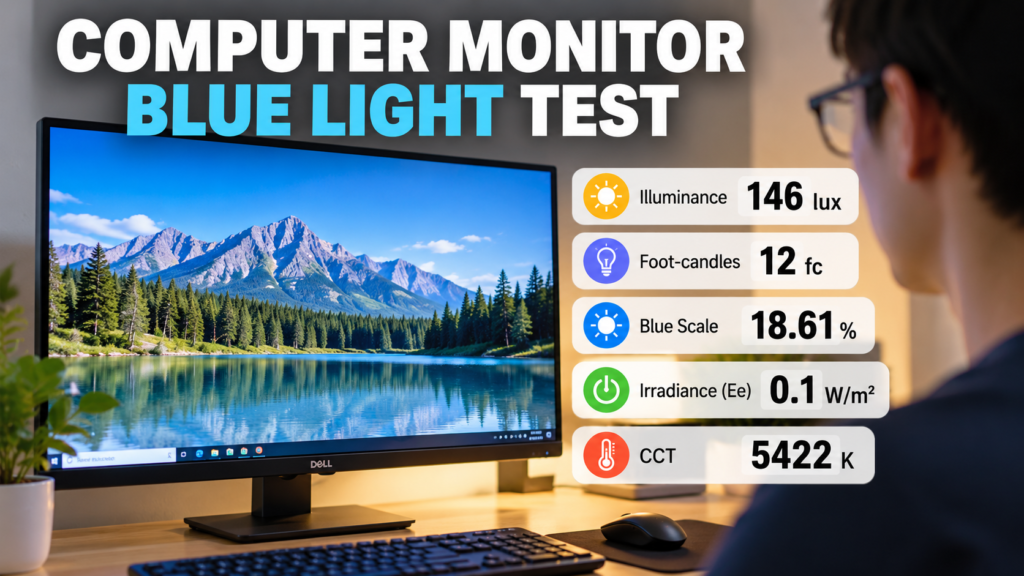
Computer monitors produce visible light that includes a blue-light component. But what does that light actually look like when measured at a typical workstation?
We performed a practical measurement on a Dell computer monitor using an AquaHorti light meter.
Short answer: under the conditions shown in this test, the meter displayed approximately 146 lux, 12 fc, an 18.61% Blue Scale reading, 0.1 W/m² irradiance (Ee), and a CCT of 5422 K.
These values describe the light measured in this specific setup. They should not be interpreted as medical or eye-safety thresholds.
Watch the Original Monitor Blue-Light Test
The original AquaHorti test video was published on March 31, 2025.
How Was the Computer Monitor Tested?
The video shows a Dell monitor being used in a normal desktop workstation environment.
The light sensor was positioned in front of the display to measure the light reaching the measurement point.
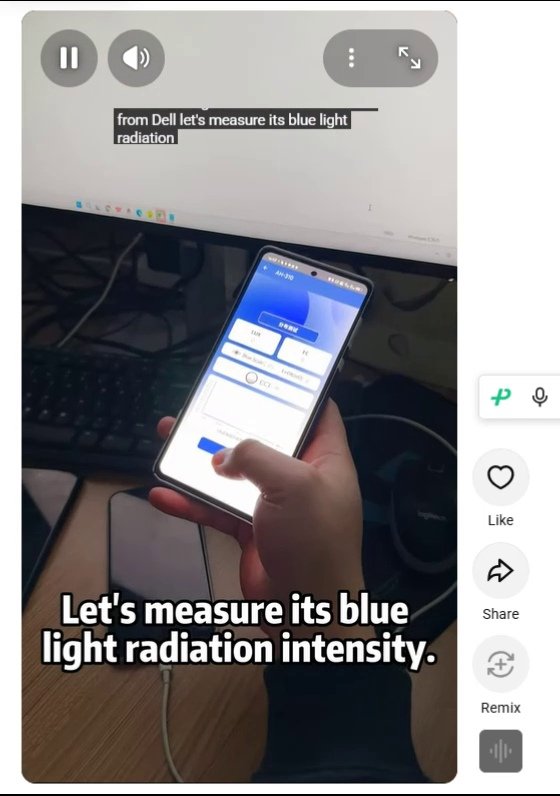
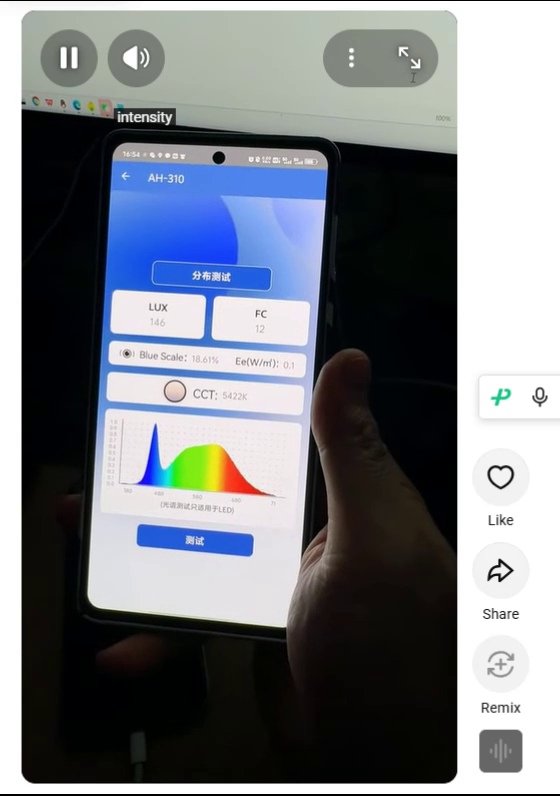
The test recorded illuminance, foot-candles, Blue Scale, irradiance and correlated color temperature, together with a spectrum preview.
Because screen output can change with brightness, displayed content, viewing distance and display settings, these measurements represent only the conditions shown in the video.
What Did the Meter Show?
The measurement screen displayed approximately:
| Measurement | Reading shown in the video |
|---|---|
| Illuminance | 146 lux |
| Foot-candles | 12 fc |
| Blue Scale | 18.61% |
| Irradiance (Ee) | 0.1 W/m² |
| CCT | 5422 K |
The spectrum preview showed a distinct blue-region peak together with broader visible-light output across the green, yellow and red portions of the spectrum.
Test result
The computer monitor produced a measurable blue-light component, with an 18.61% Blue Scale reading under this particular test condition.
The percentage is useful as a comparative measurement parameter. It is not a medical risk percentage.
What Does an 18.61% Blue Scale Reading Mean?
The Blue Scale value can be useful when comparing different display conditions.
For example, the same monitor could be measured while changing:
- screen brightness,
- normal mode versus night mode,
- color temperature settings,
- different display presets,
- or viewing distance.
If all other conditions remain the same, changes in the measured Blue Scale can help show how the spectral balance of the display has changed.
It should not be interpreted as meaning that “18.61% of the light is harmful” or that the display has an 18.61% health risk.
What Does 5422 K CCT Tell Us?
The measured correlated color temperature in this test was approximately 5422 K.
CCT describes the overall visual appearance of nominally white light, ranging from warmer-looking lower-CCT light to cooler-looking higher-CCT light.
It does not directly measure blue-light safety.
Two light sources with similar CCT values can still have different spectral distributions, which is why a spectrum or blue-light-related measurement provides additional information.
What Does the 0.1 W/m² Reading Mean?
The App displayed an irradiance value, Ee, of approximately 0.1 W/m².
Irradiance describes optical power reaching a unit area at the measurement point.
This value depends strongly on the sensor position, distance from the monitor, screen brightness and displayed content.
For that reason, the reading should be treated as a measurement from this specific setup rather than a universal value for computer monitors.
Does Computer Monitor Blue Light Damage Your Eyes?
A light meter cannot determine that from a single measurement.
It measures characteristics of the light reaching the sensor. It does not diagnose retinal damage, digital eye strain or any other medical condition.
The American Academy of Ophthalmology states that current evidence does not show a meaningful link between blue light from digital devices and damage to the human retina. Screen-related discomfort is more commonly associated with prolonged screen use and reduced blinking.
Therefore, this experiment should be interpreted as a light measurement test, not an eye-safety assessment.
Test Limitations
This was a practical demonstration rather than a standardized photobiological safety test.
The video does not document a fixed sensor-to-screen distance, calibrated display brightness, standardized test image, controlled ambient lighting or laboratory spectral calibration.
The readings should therefore be interpreted as measurements from this particular monitor and setup, not as universal values for Dell monitors or computer displays in general.
Why Can Monitor Measurements Change?
Computer displays do not produce a fixed optical output under every condition.
Brightness settings can change the amount of light emitted by the screen.
Displayed content also matters. A mostly white screen can produce different illuminance and spectral readings from a dark interface.
Display modes such as Night Light, Eye Comfort or warmer color-temperature settings can also change the spectral distribution.
Viewing distance and sensor angle can further affect the measured result.
For meaningful comparisons, change only one variable at a time.
A Better Monitor Comparison Test
A useful follow-up experiment would be to keep the same:
monitor → screen content → brightness → sensor distance → sensor angle
and compare:
Normal Mode vs Night Mode
or:
100% Brightness vs 50% Brightness
This creates a clearer A/B test and makes changes in lux, Blue Scale, irradiance and CCT easier to interpret.
Related Blue-Light Tests
You can also see our Do Blue-Light Glasses Really Block Blue Light? A Simple Meter Test.
About the Meter Shown in the Video
The original 2025 video shows AH-310 in the app interface.
AquaHorti’s current indoor-light measurement product is AH-300, which supports LUX/FC, CCT, blue-light-related measurements and additional lighting measurement functions.
Learn more: AH-300 Light Meter – LUX, CCT & Blue-Light Measurement
Frequently Asked Questions
Does a computer monitor emit blue light?
Yes. Computer monitors emit visible light that includes a blue-light component.
What did the monitor measure in this test?
Under the conditions shown in the video, the meter displayed approximately 146 lux, 12 fc, 18.61% Blue Scale, 0.1 W/m² irradiance and 5422 K CCT.
Does an 18.61% Blue Scale reading mean 18.61% eye-damage risk?
No. Blue Scale is a measurement parameter, not a medical or eye-safety risk percentage.
Can monitor brightness change the measurement?
Yes. Screen brightness, displayed content, viewing distance, display mode, sensor angle and ambient lighting can all affect the readings.
Can a light meter determine whether a monitor is safe for your eyes?
No. A light meter measures optical characteristics. It does not diagnose eye damage or establish medical safety.