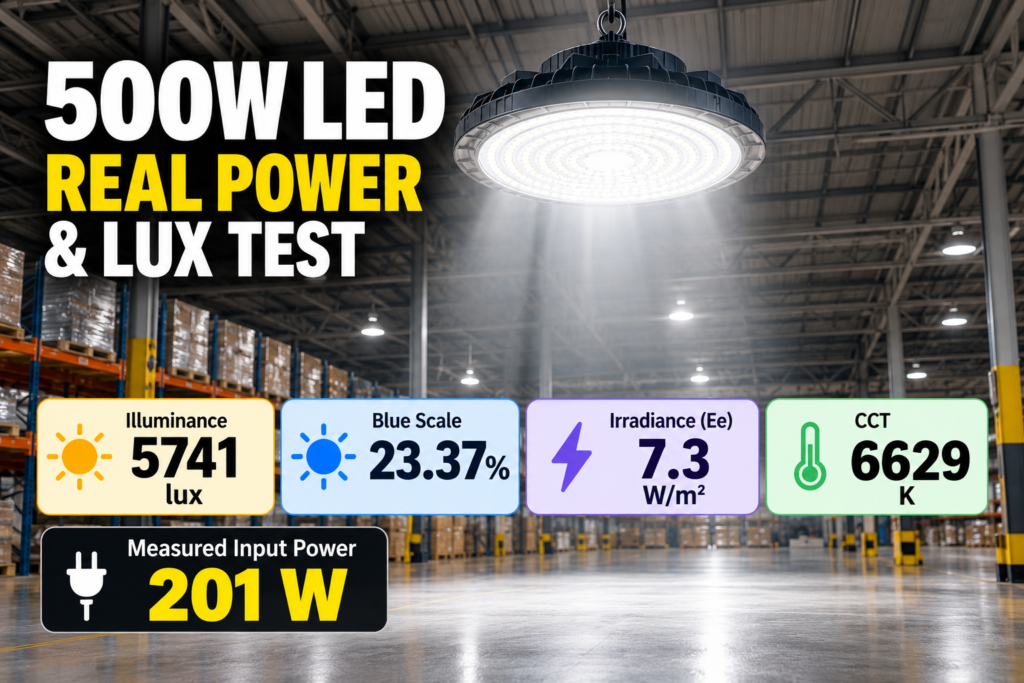
A high wattage number can make an LED fixture look more powerful on a marketplace listing. But does the number on the listing match the electrical power the fixture actually draws?
We tested a round LED high-bay-style fixture that was described as 500 W on the marketplace listing shown in the original video.
First, we checked its electrical input with a plug-in power meter. We then measured the light reaching the test point with a light meter.
Short answer: the power meter display showed approximately 201 W, while the video narration rounded the result to about 210 W. At the optical measurement point, the light meter displayed approximately 5741 lux, a 23.37% Blue Scale reading, 7.3 W/m² irradiance (Ee) and a CCT of 6629 K. The measured input was about 40% of the 500 W label, or approximately 60% lower than 500 W.
These are measurements from this individual fixture and test setup. They should not be interpreted as specifications for every light sold under a similar wattage label.
Watch the Original Test
The original AquaHorti test video was published on April 3, 2025.
What Was Being Tested?
The fixture shown in the video is a round LED high-bay-style light intended to produce a high level of illumination.
According to the marketplace information referenced in the video, the light was labeled as 500 W.
Rather than relying only on the wattage number, we checked two different things:
Electrical input power — measured with a plug-in power meter.
Illuminance at the test point — measured with a light meter.
These are different measurements and answer different questions.
What Did the Power Meter Show?
The plug-in power meter display showed approximately:
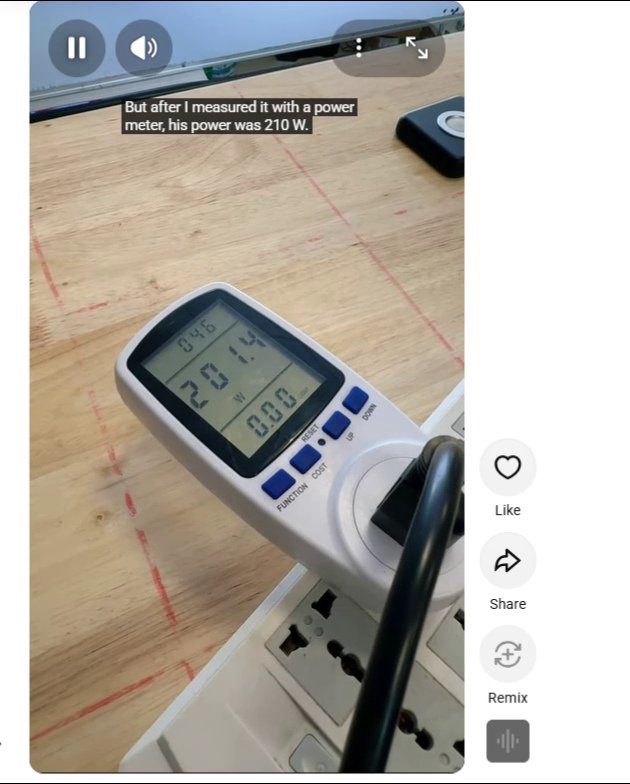
201 W
The narration and subtitles in the video describe the result as approximately 210 W.
For accuracy, this article treats the visible meter reading as approximately 201 W, while acknowledging that the original video rounded the result to about 210 W.
Compared with a 500 W label, the measured input power was substantially lower.
However, without the complete original product specification, we cannot determine whether “500 W” was intended to represent actual input power, an equivalent-wattage marketing claim, a model designation or another specification.
Electrical test result
The fixture did not draw 500 W during the test shown in the video. The visible power-meter reading was approximately 201 W.
That conclusion applies only to the individual fixture and operating condition shown.
What Did the Light Meter Show?
The optical measurement screen displayed approximately:
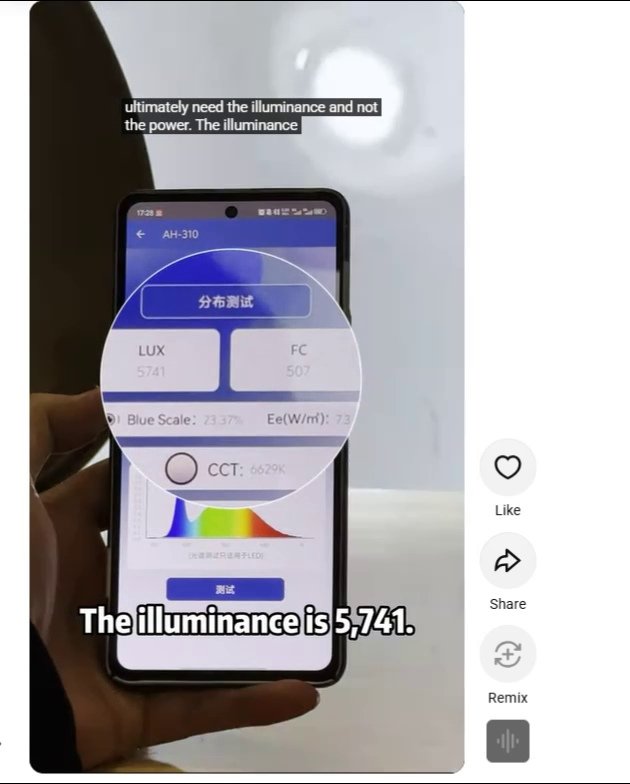
| Measurement | Reading shown in the video |
|---|---|
| Illuminance | 5741 lux |
| Foot-candles | 507 fc |
| Blue Scale | 23.37% |
| Irradiance (Ee) | 7.3 W/m² |
| CCT | 6629 K |
A note about the lux and foot-candle values
The App displayed 5741 lux and 507 fc in the same captured result.
Those values are not exact mathematical equivalents. Using the standard conversion, 5741 lux is approximately 533 fc.
For this article, 5741 lux is therefore used as the primary illuminance reading, and the displayed 507 fc value is not used for calculations.
What Does 5741 Lux Mean?
Lux measures illuminance — the amount of visible light reaching a surface at a specific measurement point.
The 5741 lux result indicates that a relatively high level of illuminance reached the sensor under the conditions used in this test.
It does not tell us the fixture’s total lumen output.
Lux can change substantially with:
- distance from the fixture,
- beam angle,
- sensor position,
- reflector design,
- fixture height,
- and the area over which the light is distributed.
The U.S. Department of Energy distinguishes illuminance from total light output: illuminance describes light reaching a surface, while lumens describe the total visible light emitted by a source.
Does Higher Wattage Mean a Brighter Light?
Not necessarily.
Watts measure electrical power input.
They do not directly measure how much usable light reaches a work surface.
A fixture can consume more electrical power but distribute that light inefficiently. Another fixture may use less power but direct a larger portion of its output toward the area being illuminated.
This is why comparing lighting products only by wattage can be misleading.
The U.S. Department of Energy recommends comparing light output in lumens rather than assuming watts represent brightness.
Can We Calculate LED Efficiency From 5741 Lux and 201 W?
No — not standard luminous efficacy.
It would be possible to divide the point illuminance by the measured power:
5741 lux ÷ approximately 201 W
but that would only create a lux-per-watt value at this specific sensor position.
It would not be the fixture’s standard luminous efficacy.
Standard lighting efficacy is expressed in:
lumens per watt (lm/W)
and requires total luminous flux together with electrical input power.
Because this video measures lux at one location rather than total lumens, it cannot establish the fixture’s certified lm/W efficacy.
Why Is Measuring Both Power and Lux Useful?
The two measurements answer different practical questions.
A power meter tells us:
How much electrical power is the fixture drawing?
A lux meter tells us:
How much illuminance reaches this particular location?
Together they provide much more useful information than a wattage label alone.
For example, two fixtures might both draw approximately 200 W but produce very different lux readings at the same work surface because of differences in optics and beam distribution.
What Does the 6629 K CCT Mean?
The measured correlated color temperature was approximately 6629 K.
That indicates a relatively cool-looking white light.
CCT describes the visual appearance of nominally white light, but it does not fully describe the light’s spectrum.
The spectrum preview in the video also shows a pronounced blue-region peak together with broader visible output.
What Does the 23.37% Blue Scale Reading Mean?
The App displayed approximately 23.37% Blue Scale.
This measurement is best used as a comparative parameter.
For example, it could be used to compare:
- two different high-bay fixtures,
- different CCT versions,
- different dimming levels,
- or the same fixture before and after changing its operating mode.
It should not be interpreted as a health-risk percentage or eye-safety rating.
What Does 7.3 W/m² Irradiance Mean?
The App displayed an irradiance value, Ee, of approximately 7.3 W/m² at the sensor position.
Irradiance represents optical power reaching a unit area.
Like lux, it depends strongly on distance, fixture orientation and measurement geometry.
It should therefore be treated as a result from this particular setup rather than a universal specification of the fixture.
Test Limitations
This was a practical field test rather than a standardized electrical or photometric certification test.
The video did not document:
- a calibrated laboratory power analyzer,
- total luminous flux,
- a standardized photometric test distance,
- complete beam distribution,
- integrating-sphere measurements,
- controlled fixture temperature,
- or an LM-79 laboratory test.
The original marketplace listing is also not reproduced in full in the video, so this test cannot determine exactly how the seller defined the “500 W” claim.
The results should therefore be interpreted as:
approximately 201 W electrical input and 5741 lux at the test point for this individual fixture under the conditions shown.
They should not be interpreted as a certification of the product’s total lumen output or luminous efficacy.
What Is the Most Useful Takeaway?
The most useful lesson from this test is simple:
Do not use a wattage number alone to judge how well a light will illuminate your space.
Check electrical power when power consumption matters, and measure illuminance at the actual working area when lighting performance matters.
For warehouses, workshops and other large spaces, the final question is not simply:
“How many watts is the light?”
A more useful question is:
“How much usable illuminance reaches the area where I need the light?”
Related Lighting Measurement Tests
For another comparison of electrical power and illuminance, see our 55W Halogen vs 7W LED: Lux and Power Comparison Test
You can also see our Does LED Brightness Decrease Over Time? 2-Year vs 6-Month Lux Test.
About the Meter Shown in the Video
The original 2025 video shows AH-310 in the app interface.
AquaHorti’s current indoor-light measurement product is AH-300, which supports LUX/FC, CCT and additional lighting measurements.
Learn more: AH-300 Light Meter – LUX, CCT & Blue-Light Measurement
Frequently Asked Questions
Was the 500W LED light actually drawing 500 watts?
No. In the video, the visible plug-in power-meter display showed approximately 201 W. The narration rounded the measurement to about 210 W.
Does that prove the 500W product listing was false?
Not necessarily. The video does not show the complete product specification, so we cannot determine whether 500 W represented actual input power, an equivalent rating, a model designation or another marketing specification.
How bright was the light in the test?
The light meter displayed approximately 5741 lux at the measurement point.
Can 5741 lux tell us how many lumens the fixture produces?
No. Lux is illuminance at a specific point. Total lumen output cannot be determined reliably from one lux measurement without additional information about distance, area and light distribution.
Can we calculate lumens per watt from this video?
No. Standard luminous efficacy requires total lumen output and electrical input power. This test measured point illuminance rather than total lumens.
Why measure watts and lux separately?
Watts indicate electrical power consumption, while lux indicates how much visible light reaches a particular surface. Measuring both gives a more useful picture of real-world lighting performance.