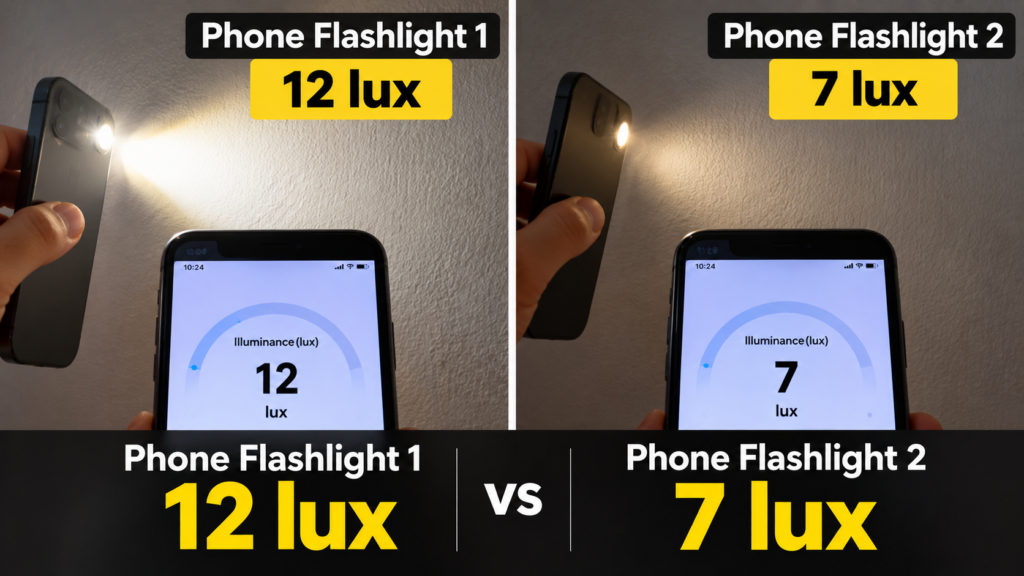
Smartphone flashlights can look surprisingly bright in a dark room, but how much illuminance actually reaches a surface?
On April 16, 2025, AquaHorti performed a simple comparison using two smartphone flashlights and a light sensor positioned on a wall.
Short answer: under the conditions shown in the video, one smartphone flashlight produced approximately 12 lux at the sensor, while the second measurement was approximately 7 lux.
The 12-lux reading was approximately 1.71 times the 7-lux reading at that specific measurement point. However, this should not be interpreted as proof that one phone’s flashlight has 12 times the total light output of the other.
Watch the Original Smartphone Flashlight Test
The original AquaHorti video was published on April 16, 2025.
How Was the Smartphone Flashlight Test Performed?
A light sensor was positioned on a wall.
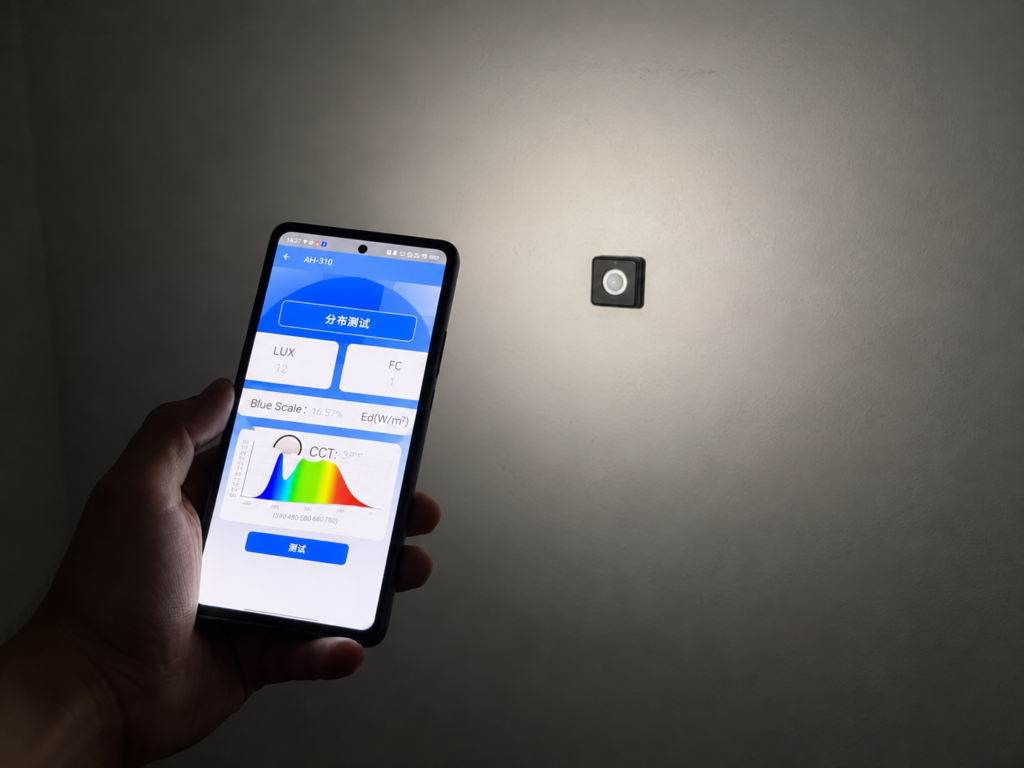
A smartphone flashlight was aimed toward the sensor, and the illuminance reading was viewed on the measurement app.
The first flashlight test displayed approximately:
12 lux
The video then moved to a second smartphone flashlight comparison.
The second measurement displayed approximately:
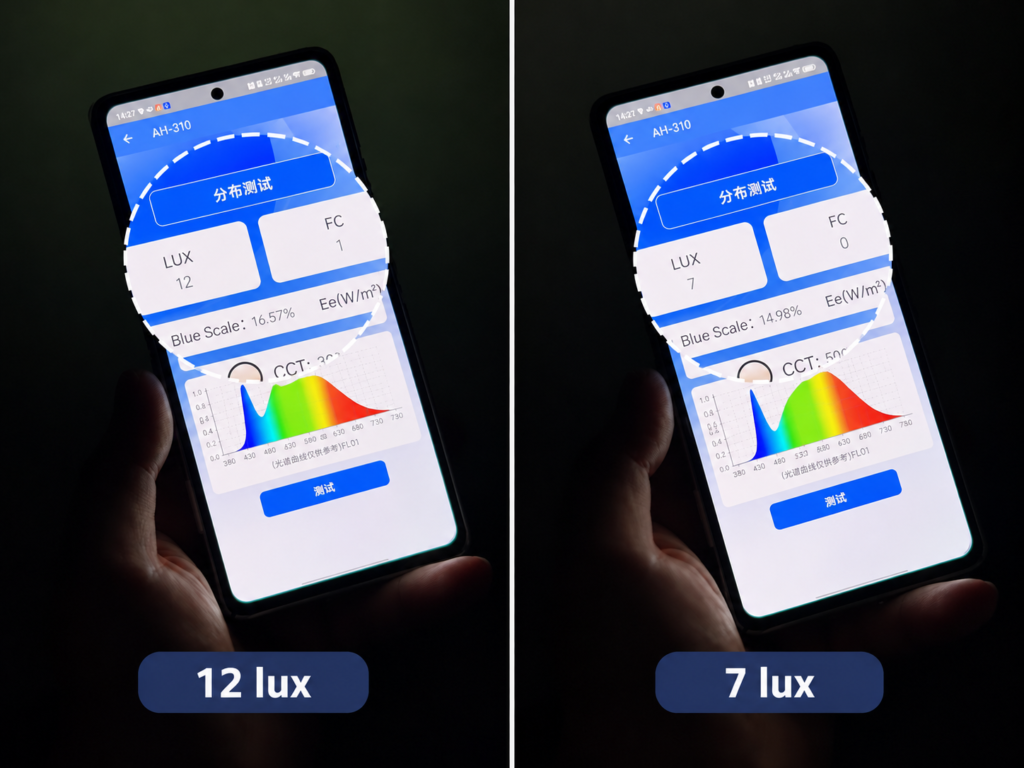
7 lux
This was a practical demonstration rather than a standardized flashlight-output test.
What Did the Meter Show?
| Smartphone flashlight test | Illuminance at sensor |
|---|---|
| Test 1 | 12 lux |
| Test 2 | 7 lux |
Test result
The visible readings differed substantially:
12 lux vs 7 lux
At the sensor position used in the video, the first reading was approximately 1.71× the second reading.
But this comparison describes illuminance at one measurement point, not total flashlight output.
What Does 12 Lux Mean?
Lux measures illuminance — how much visible light reaches a surface.
A reading of 12 lux means more light reached the sensor than during the approximately 7-lux measurement.
But lux depends strongly on measurement geometry.
Changing the distance between the flashlight and sensor can change the reading substantially.
The Illuminating Engineering Society explains that, for a point-like light source under appropriate conditions, illuminance varies inversely with the square of distance. Illuminating Engineering Society
That means even a relatively small change in flashlight-to-sensor distance can have a large effect on the measured lux.
Does 12 Lux Mean the Flashlight Produces 12 Times More Total Light?
No.
This is an important distinction.
The video shows:
12 lux at one sensor position
versus:
7 lux at another measurement
Lux does not directly tell us total lumen output.
Two flashlights can produce different point lux readings because of differences in:
- beam angle,
- beam focus,
- distance,
- alignment,
- LED output,
- lens design,
- and flashlight brightness settings.
A narrow beam can produce a higher center lux value without necessarily producing proportionally more total light.
Why Does Flashlight Distance Matter So Much?
For directional light measurements, distance is one of the most important variables.
If a flashlight is moved closer to the sensor, the measured illuminance normally increases.
If it is moved farther away, the illuminance decreases.
For a simplified point-source model:
E = I / d²
where:
- E = illuminance
- I = luminous intensity
- d = distance
The Illuminating Engineering Society defines this relationship as the inverse-square law for illuminance. Illuminating Engineering Society
This is why smartphone flashlight comparisons should keep the distance exactly the same.
Why Does Beam Alignment Matter?
A smartphone flashlight does not illuminate every direction equally.
The center of the beam may produce considerably more illuminance than the outer edge.
If one phone is aimed directly at the sensor while another is slightly off-center, the resulting lux values can differ even if their overall flashlight performance is similar.
For a meaningful comparison, both phones should be:
- at the same distance,
- at the same height,
- aimed at the same sensor position,
- held at the same angle,
- and set to comparable flashlight brightness levels.
Can Phone Flashlight Brightness Be Compared Using Lux?
Yes — if the test conditions are controlled.
Lux is useful for comparing how much illuminance different phone flashlights deliver to the same target.
A practical comparison could place each phone at a fixed distance, such as:
0.5 m
and then measure the center of the beam using the same sensor position.
The results could then be compared directly.
For example:
| Phone | Distance | Center illuminance |
|---|---|---|
| Phone A | 0.5 m | Lux |
| Phone B | 0.5 m | Lux |
| Phone C | 0.5 m | Lux |
This would provide a much stronger comparison than measurements taken at uncontrolled positions.
Does a Brighter Phone Flashlight Always Mean a Better Flashlight?
Not necessarily.
Higher center illuminance can be useful when you need a concentrated beam to see a small area at a distance.
But other situations may benefit from a wider, more uniform beam.
Useful flashlight characteristics can include:
- center illuminance,
- beam width,
- beam uniformity,
- usable distance,
- brightness settings,
- and battery consumption.
A single lux measurement captures only one part of flashlight performance.
Why Can Two Phones Produce Very Different Lux Readings?
Several factors can contribute.
LED output
Different phones use different flashlight LEDs and drive currents.
Optical design
The shape of the lens and surrounding camera module can affect how the light is distributed.
Beam angle
A narrower beam may concentrate more light onto the sensor.
Distance
Even a modest change in test distance can significantly affect lux.
Alignment
The sensor may receive a much stronger reading when positioned at the center of the beam.
Flashlight settings
Some phones support multiple flashlight intensity levels.
If the two phones are not using comparable settings, the readings cannot be treated as a controlled product comparison.
Test Limitations
This was a simple practical demonstration rather than a standardized smartphone flashlight test.
The video does not fully document:
- exact flashlight-to-sensor distance for both phones,
- identical beam alignment,
- flashlight brightness level,
- total lumen output,
- repeated measurements,
- beam width,
- or calibrated luminous-intensity measurements.
Therefore, the 12 lux and 7 lux values should be interpreted as measurements from the specific setups shown in the video.
They should not be used to claim that one smartphone produces 1.71 times the total flashlight output of the other, because total lumen output was not measured.
How Could This Test Be Improved?
A stronger smartphone flashlight comparison would use a fixed test fixture.
For example:
1. Fix the sensor to the wall.
2. Position each smartphone exactly 50 cm from the sensor.
3. Align the flashlight center with the sensor.
4. Use the highest flashlight setting on each phone.
5. Allow the reading to stabilize.
6. Repeat each test three times.
The average lux value could then be used for comparison.
An even better test could also measure several positions around the beam center to compare beam width and uniformity.
What Is the Main Takeaway?
The main lesson from this video is not simply that one phone is “1.71 times brighter.”
The stronger conclusion is:
Smartphone flashlight illuminance can differ substantially, but lux comparisons only become meaningful when distance, alignment and flashlight settings are controlled.
In this practical demonstration, the visible readings were:
12 lux
and
7 lux
at the sensor position.
Related Lighting Measurement Tests
For another test showing how beam distribution changes center illuminance, see our LED Beam Angle vs Lux Test: 10°–50°.
You can also see our 23W CFL vs 7W LED: Same 873 Lux Test, which compares two light sources at approximately the same measurement position.
About the Meter Shown in the Video
The original 2025 video shows AH-310 in the app interface.
AquaHorti’s current indoor-light measurement product is AH-300, which supports illuminance and correlated color-temperature measurements.
Learn more: AH-300 Light Meter – LUX & CCT Measurement
Frequently Asked Questions
How bright was the first smartphone flashlight in the test?
The first visible measurement was approximately 12 lux at the sensor position.
How bright was the second smartphone flashlight?
The second visible measurement was approximately 7 lux.
Does the 12 lux vs 7 lux result mean one flashlight was 1.71 times more powerful?
No. The point illuminance reading was approximately 1.71 times higher, but total flashlight power or lumen output was not measured.
Does flashlight distance affect lux?
Yes. Illuminance can change greatly with distance, so phone-to-sensor distance should be kept identical when comparing flashlights. Illuminating Engineering Society
Why can two smartphone flashlights have different lux readings?
LED output, optics, beam angle, distance, alignment and flashlight brightness settings can all affect the measured illuminance.
What is the best way to compare smartphone flashlight brightness?
Use the same sensor, fixed distance, identical alignment and comparable flashlight settings, then repeat each measurement several times.