How much light is available outdoors on a cloudy-looking day?
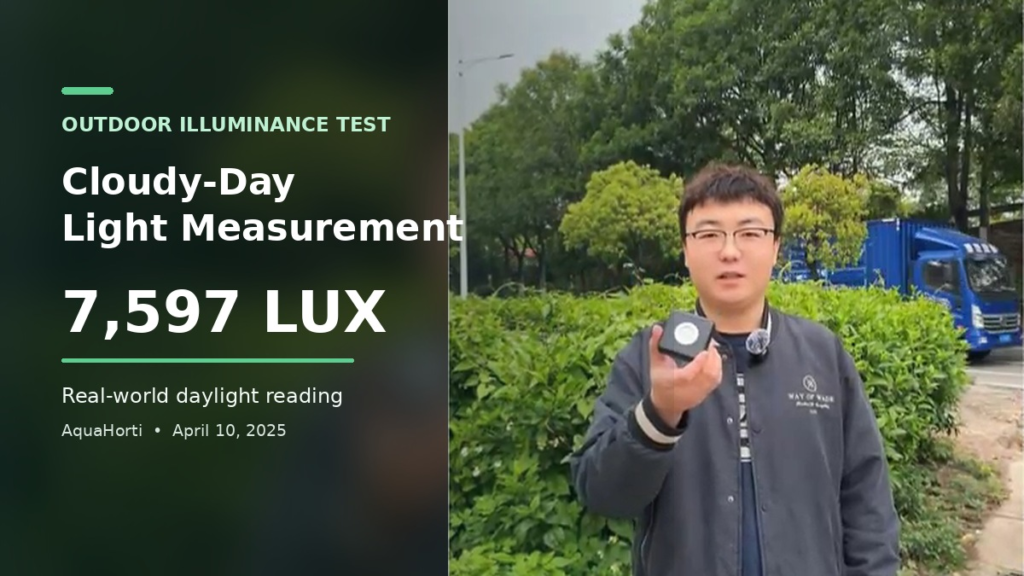
On April 10, 2025, AquaHorti conducted a practical outdoor illuminance test using an AH-310 light meter. The visible reading in the video was 7,597 lux.
This measurement provides a real-world example of outdoor daylight illuminance under the conditions shown in the video. It also demonstrates why outdoor light levels should be measured rather than estimated from weather descriptions alone.
Key result: The AH-310 displayed 7,597 lux during this outdoor measurement. This is a single observed reading, not a representative value for every cloudy day.
Watch the Original Outdoor Lux Test
The original AquaHorti video was published on April 10, 2025.
How Was the Outdoor Light Measured?
The test was performed outdoors in a tree-lined area under a gray, cloudy-looking sky.
The presenter used an AH-310 light meter to check the illuminance level and viewed the measurement on a smartphone.
The purpose of the demonstration was straightforward: measure the available light under the actual outdoor conditions rather than relying on a visual impression of how bright or dim the day appeared.
The video shows the meter being held outdoors in a green, tree-lined area before the illuminance reading is displayed.
What Was the Measured Lux Value?
The clearly stated reading in the video was:
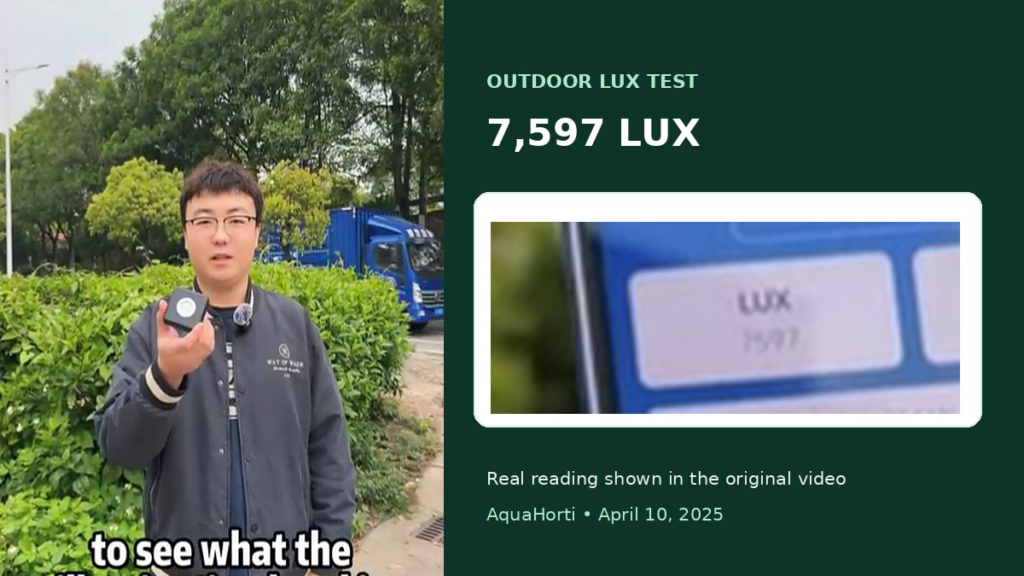
7,597 lux
Lux is the unit used to measure illuminance, or the amount of visible light reaching a surface per unit area.
This value describes the light reaching the sensor at the time and position of the measurement. It does not represent the total light emitted by the sun, nor does it describe every location in the surrounding environment.
The reading should therefore be understood as a snapshot of the outdoor lighting conditions at that particular moment.
Does a Cloudy Day Always Have Low Illuminance?
No. A cloudy sky does not correspond to one fixed illuminance level.
Outdoor light depends on several variables, including:
- Cloud thickness and coverage
- Time of day and solar position
- The amount of open sky visible to the sensor
- Nearby trees, buildings and other obstructions
- Reflections from surrounding surfaces
- Sensor orientation and measurement position
Clouds can reduce direct sunlight, but diffuse daylight can still illuminate the surrounding area.
Consequently, two cloudy days can produce substantially different lux readings. Even measurements taken on the same day can differ when the sensor is moved to another location or pointed in a different direction.
Why Measure Lux Instead of Judging Brightness by Eye?
Human vision adapts to different lighting conditions. As a result, the same environment can appear relatively bright or dim depending on what a person has recently been looking at and how their eyes have adapted.
A lux meter provides a numerical measurement that can be recorded and compared.
For example, a recorded value of 7,597 lux allows someone to document the measured condition and compare it with another reading taken later, provided the measurement method and relevant environmental conditions are also considered.
This is useful for outdoor lighting observations, daylight studies and comparisons between different locations.
What Can the 7,597 Lux Reading Tell Us?
The reading establishes one specific observation: the meter displayed 7,597 lux during the outdoor test.
It can serve as a reference point for a future comparison, such as measuring at the same location under different weather conditions.
However, one measurement cannot establish:
- The average illuminance for the entire day
- The typical illuminance of all cloudy days
- The illuminance at other locations
- How much illuminance changes throughout the day
- Whether the reading would be the same with a differently oriented sensor
To answer those questions, repeated measurements and additional environmental records would be needed.
How to Perform a More Reliable Outdoor Lux Comparison
For a useful comparison between different outdoor conditions, follow a consistent measurement procedure.
1. Keep the sensor orientation consistent.
Point the sensor in the same direction and maintain the same angle for each reading.
2. Record the measurement location.
Nearby trees, walls, buildings and other obstructions can affect the amount of light reaching the sensor.
3. Record the time and weather.
Note the time of day and whether the sky is clear, partly cloudy or overcast.
4. Take repeated readings.
Collect several measurements at the same position instead of relying on a single reading.
5. Repeat the test under different conditions.
Measurements taken at the same location on different days can help illustrate how daylight changes with the weather.
Following these steps makes comparisons more meaningful and helps distinguish real environmental changes from differences caused by measurement technique.
Test Limitations
This was a practical outdoor measurement demonstration, not a standardized meteorological study.
The video does not provide a complete record of cloud coverage, solar position, exact sensor orientation, repeated measurements or simultaneous reference-instrument readings.
Therefore, the displayed value of 7,597 lux should be interpreted as a reading from the specific test conditions shown in the video.
It should not be treated as a universal outdoor illuminance value or as a standard for cloudy weather.
What Is the Main Takeaway?
Outdoor lighting conditions are not fixed, and a visual description such as “cloudy” is not enough to determine the exact illuminance.
In this AquaHorti field demonstration, the AH-310 displayed 7,597 lux.
The most useful lesson is to measure outdoor light directly and record the conditions surrounding each reading. This provides a more reliable basis for comparing daylight than relying on visual impressions alone.
About the Light Meter Shown in the Video
The original 2025 video demonstrates the AH-310.
For information about AquaHorti’s current indoor-light measurement product, see the AquaHorti AH-300 Light Meter.
Related Lighting Measurement Tests
For another real-world comparison of illuminance and electrical power, see our 55W Halogen vs 7W LED: Lux and Power Comparison Test.
You can also read our 500W LED High-Bay Actual Power & Lux Test to learn why measured lighting performance should be evaluated rather than inferred from product labels alone.
Frequently Asked Questions
What was the outdoor lux reading in the AquaHorti video?
The AH-310 displayed 7,597 lux during the outdoor measurement shown in the video published on April 10, 2025.
What does 7,597 lux mean?
It means the measured illuminance at the sensor was 7,597 lux at that moment and position. It is not a measurement of total sunlight output.
Can cloudy weather still produce measurable outdoor illuminance?
Yes. Diffuse daylight can illuminate outdoor surfaces even when direct sunlight is reduced by clouds. The actual lux value depends on the sky and measurement conditions.
Is 7,597 lux the average illuminance on a cloudy day?
No. The video shows a single reading, not a daily average or a statistical study of cloudy weather.
Why can two outdoor lux measurements differ?
Differences in weather, time of day, sensor orientation, measurement position, nearby obstructions and reflected light can all affect the result.
How can outdoor illuminance be compared accurately?
Use a consistent sensor orientation and location, record the time and weather, and take repeated readings under clearly documented conditions.