Can two light settings produce nearly the same total luminous flux but still give different lux readings at a specific point?
In this test, we compared a warm-white setting near 2700K with a cool-white setting near 5700K. We first measured total luminous flux with an integrating sphere, then adjusted the cool-white setting so its lumen output was close to the warm-white setting.
Finally, we compared illuminance at the measurement position.
The result was:
2700K setting: approximately 1,030 lux
5700K setting: approximately 970 lux
The difference was about 60 lux, or approximately 6.2% relative to the 970-lux reading.
However, this does not mean that 2700K light is inherently brighter than 5700K light. The experiment shows why total lumens and point illuminance should not be treated as the same measurement.
Video published: April 17, 2025
Direct Answer: Does Color Temperature Affect Lux?
Under the specific conditions shown in this test, changing the color-temperature setting changed the measured illuminance at the test point even after total luminous flux was brought close to the same level.
The warm setting produced approximately 1,030 lux, while the cool setting produced approximately 970 lux.
But color temperature alone should not be treated as the cause of this difference.
Lux at a specific location can also be affected by the light distribution, LED channel arrangement, optical system, measurement geometry and the spectral response of the illuminance meter.
The key result is therefore:
Nearly equal lumens do not necessarily produce exactly the same lux at every measurement point.
What Was Tested?
The test used a tunable white-light source and an approximately 2-meter integrating sphere to measure total luminous flux.
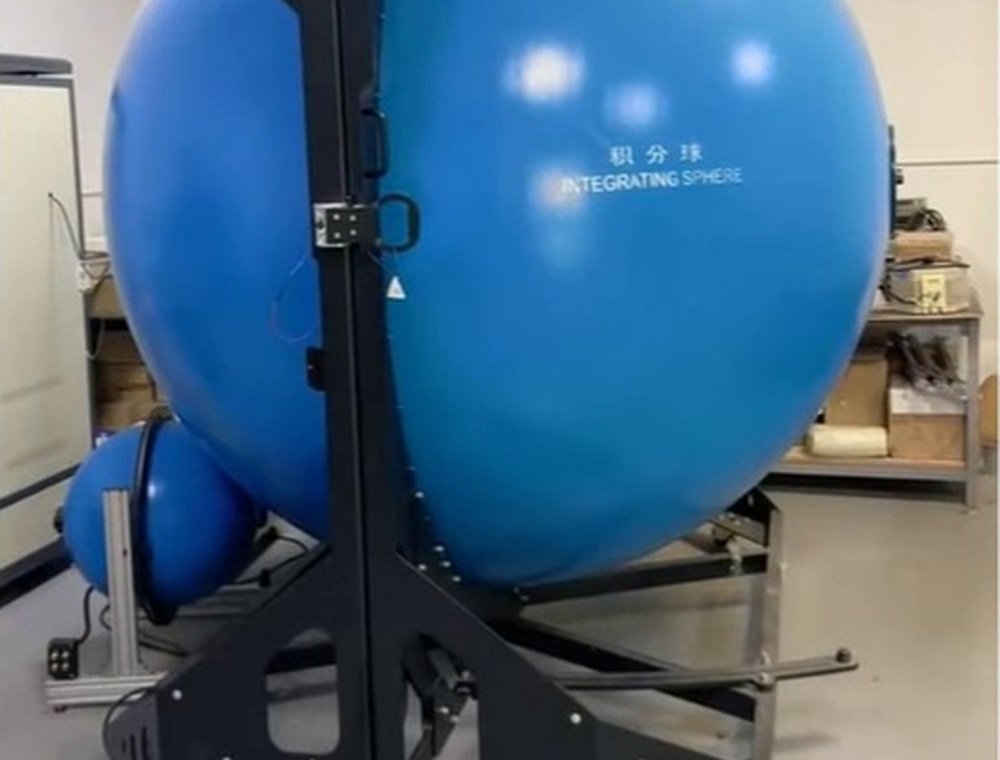
The light was first tested at a warm-white setting near 2700K.
The integrating-sphere system displayed:
| Test condition | Measured CCT | Luminous flux |
|---|---|---|
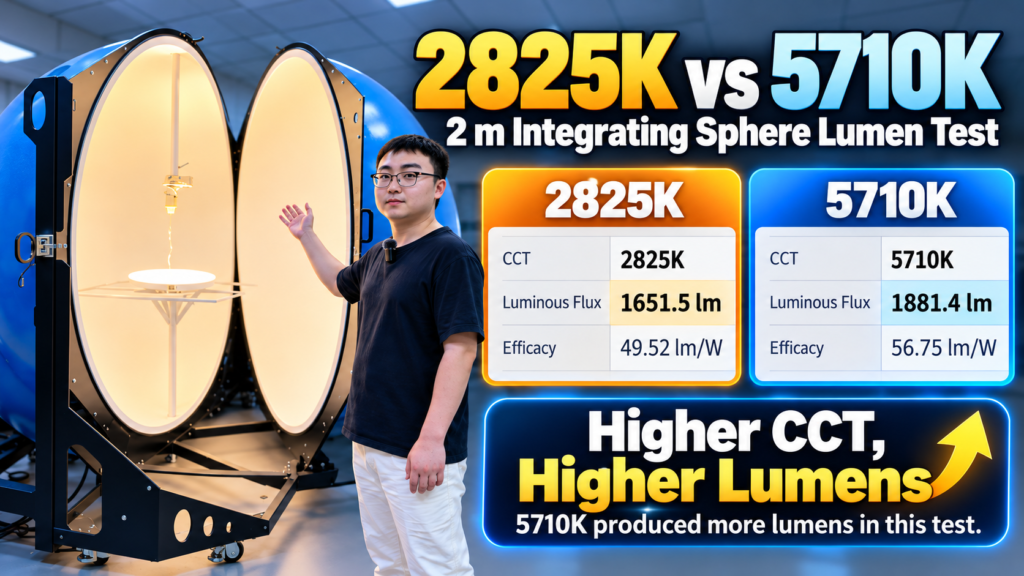
| Warm-white setting | 2,825 K | 1,651.5 lm |
| Cool-white setting, full output | 5,710 K | 1,881.4 lm |
| Cool-white setting, reduced output | 5,712 K | 1,685.4 lm |
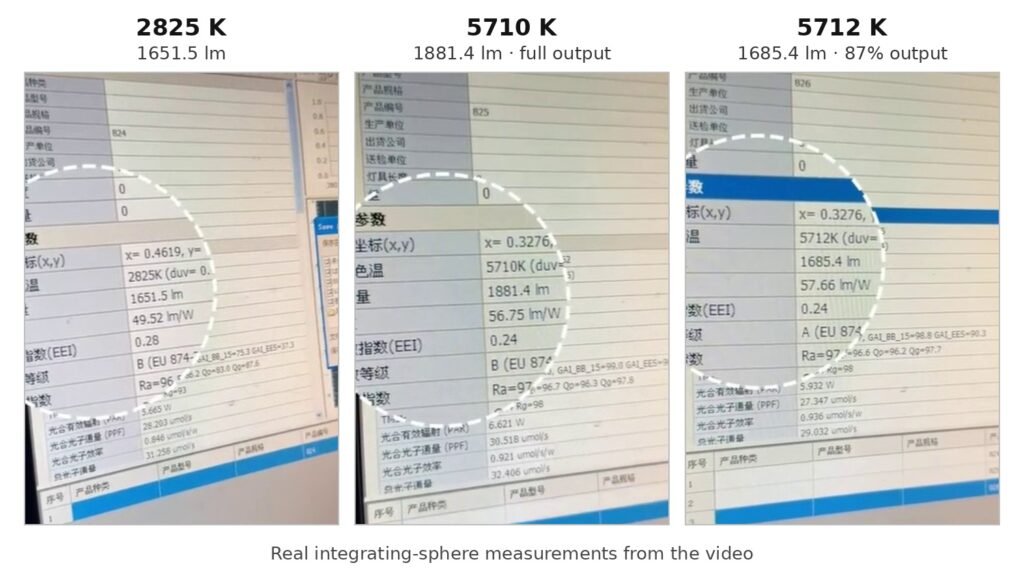
At full output, the cool-white setting produced about 13.9% more total luminous flux than the warm-white setting.
Because the goal was to compare illuminance with approximately similar lumen output, the cool-white brightness was reduced.
Why Was the 5700K Brightness Reduced?
At full output, the approximately 5700K setting measured:
1,881.4 lumens
The approximately 2700K setting measured:
1,651.5 lumens
That would not be a useful comparison if the goal were to examine illuminance with similar total light output.
The brightness of the 5700K setting was therefore reduced to approximately 87%.
The integrating sphere then measured:
1,685.4 lumens
This was only about 2.1% higher than the 1,651.5-lumen warm-white result.
The two settings were therefore much closer in total luminous flux before the point-illuminance comparison was made.
What Did the Lux Meter Show?
After the lumen output had been brought close together, illuminance was measured at the position shown in the video.
The approximately 5700K condition produced:
970 lux
The warmer approximately 2700K condition produced:
1,030 lux
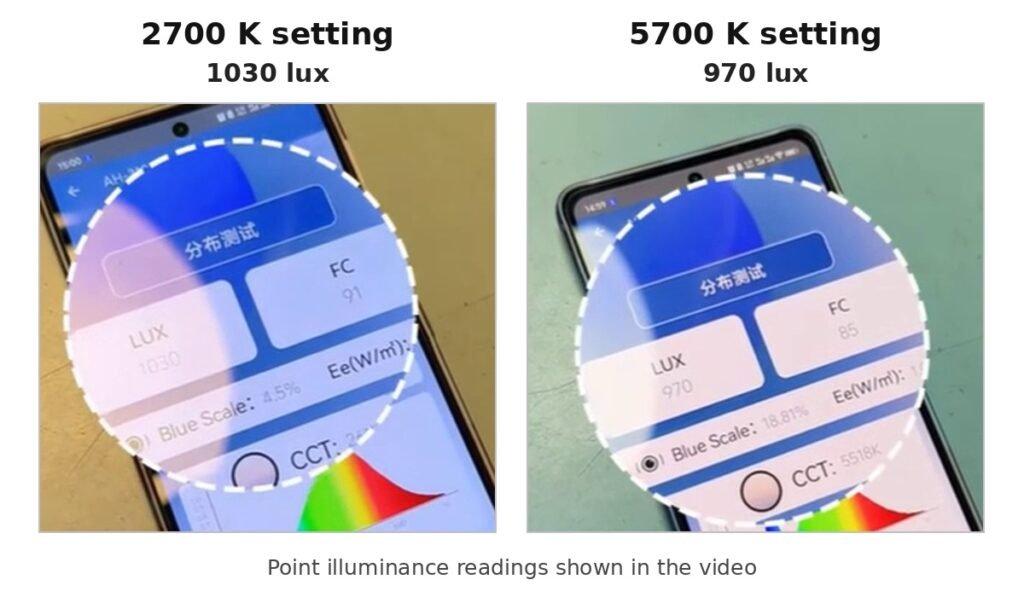
That is a difference of:
60 lux
Using the 970-lux measurement as the reference:
(1,030 − 970) ÷ 970 × 100 ≈ 6.2%
So the warm setting produced approximately 6.2% higher illuminance at this specific measurement point.
This is a point measurement and should not be interpreted as a 6.2% increase in total light output.
Lumens and Lux Are Not the Same Thing
This distinction is the most important part of the experiment.
Lumens describe luminous flux — the total quantity of visible light emitted by a source.
Lux describes illuminance — how much luminous flux reaches a unit area at a particular surface or measurement position.
The Illuminating Engineering Society defines one lux as one lumen per square meter.
Therefore, a lamp can have the same or nearly the same total lumen output while producing different lux values at an individual point if the distribution of the light changes.
Why Can Similar Lumens Produce Different Lux?
There are several possible reasons.
1. Light Distribution
Total luminous flux measures light emitted in all directions.
A lux meter measures the light reaching one specific location.
If one LED setting sends slightly more light toward the measurement point, its lux value can be higher even when total lumens are similar.
2. Different LED Channels
Many tunable-white luminaires create different color temperatures by changing the relative output of warm-white and cool-white LED channels.
Those LEDs may not have perfectly identical positions, optics or beam distributions.
Changing the color-temperature setting can therefore slightly change the spatial distribution of the emitted light.
3. Measurement Geometry
Distance, detector position and angle can all affect illuminance.
Even small differences can matter when comparing two measurements.
4. Spectral Response of the Meter
An illuminance meter is designed to approximate the photopic spectral sensitivity of the human eye.
IES notes that illuminance meters intended to respond accurately to different spectral distributions need appropriate spectral correction, while cosine correction is important for light arriving from different directions. Illuminating Engineering Society
That is another reason why measurements involving different spectral distributions should be interpreted carefully.
Why Use an Integrating Sphere?
An integrating sphere is designed to measure the total luminous flux of a light source rather than the illuminance at one specific location.
NIST uses an integrating-sphere method for realizing and calibrating the lumen, the SI unit of luminous flux.
That makes the integrating-sphere measurement useful in this experiment because it provides a separate measurement of total light output before the point lux readings are compared.
This allows us to distinguish between:
total luminous flux → lumens
and
illuminance at a location → lux
Does 2700K Produce More Lux Than 5700K?
Not necessarily.
This experiment should not be interpreted as a general rule that 2700K lighting always produces more lux than 5700K lighting.
In this particular setup:
- the approximately 2700K condition measured 1,030 lux
- the approximately 5700K condition measured 970 lux
while their total luminous flux values were relatively close.
Another luminaire with different LEDs, optics or beam distribution could produce a different result.
The useful conclusion is not that one color temperature is universally brighter.
The useful conclusion is that:
Color temperature, lumens and point illuminance are different characteristics and should be measured separately when a precise comparison is required.
What Did the Full-Output Test Show?
There is another useful observation in the video.
Before the lumen outputs were matched, the approximately 5700K setting produced:
1,881.4 lumens
while the approximately 2700K setting produced:
1,651.5 lumens
That is about 13.9% more luminous flux at the cool-white full-output setting.
This result applies only to the tested light and operating conditions.
It should not be generalized to all 2700K and 5700K LED products.
Test Limitations
This was a practical comparison of one tunable light source under the conditions shown in the video.
The test does not establish that one color temperature always produces higher illuminance than another.
Factors including luminaire design, LED channel layout, optical distribution, distance, measurement position, detector orientation and instrument spectral response can influence the result.
The approximately matched lumen values were also not identical:
1,651.5 lm vs 1,685.4 lm
a difference of about 2.1%.
For that reason, the 1,030-lux and 970-lux readings should be treated as observations from this experiment rather than a universal conversion between color temperature and illuminance.
Related Lighting Measurement Tests
For another example of why total output and point illuminance should not be confused, see our 23W CFL vs 7W LED: Same 873 Lux Test.
You can also see how optical distribution changes center illuminance in our LED Beam Angle vs Lux Test: 10°–50°.
For another color-temperature measurement example, see LED Color Temperature: Label vs Measured CCT Test.
About the Light Meter
The video shows an illuminance and color-temperature measurement interface used to compare the two lighting conditions.
For our current LUX and CCT measurement solution:
Learn more: AH-300 Light Meter – LUX & CCT Measurement
Frequently Asked Questions
Does color temperature affect lux?
It can affect the measured lux in a specific lighting system, but color temperature alone does not determine illuminance. Light distribution, total lumen output, optics, geometry and the measurement instrument can also influence the result.
What was the lux difference between 2700K and 5700K in this test?
The approximately 2700K condition measured about 1,030 lux, while the approximately 5700K condition measured about 970 lux at the test position shown in the video.
How much higher was 1,030 lux than 970 lux?
It was approximately 6.2% higher when 970 lux is used as the reference.
Were the lumen outputs exactly the same?
No. The warm condition measured 1,651.5 lumens, while the adjusted cool condition measured 1,685.4 lumens, a difference of approximately 2.1%.
What is the difference between lumens and lux?
Lumens measure total luminous flux. Lux measures illuminance at a surface or point, with 1 lux equal to 1 lumen per square meter. Illuminating Engineering Society
Does this test prove that 2700K is brighter than 5700K?
No. It only shows what happened with this specific light source and test geometry. Different luminaires may produce different results.